

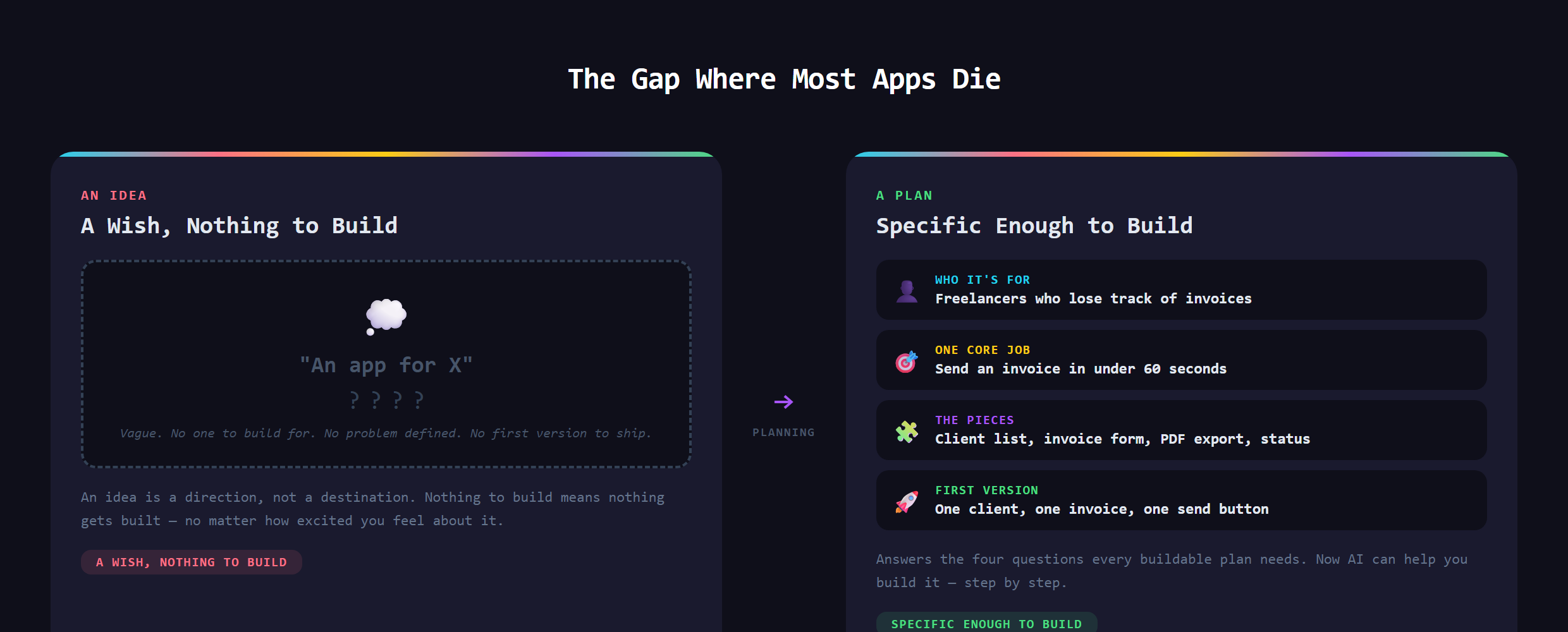
Everyone has the app idea. The reason almost none of them get built is not coding, it is that "an app for dog owners" or "like Uber but for X" is not a plan, it is a wish. The gap between a fuzzy idea and a thing you can actually build is where most projects die, quietly, before a single line exists.
In short, planning an app is the work of turning a vague idea into a specific, buildable description: who it is for, the one core thing it does, the pieces it needs, and the smallest version worth shipping first. It is the cheapest, highest-leverage step, and the one people skip.
You have seen the result of bad planning: the app that does ten things badly, next to the one that does a single thing so well you use it daily. That difference was decided on paper, before anyone built anything.
Why does planning matter more than the build?
Here is the leverage. A mistake caught while planning costs a sentence to fix. The same mistake caught after you have built around it costs days, sometimes the whole project. When you build with an AI assistant this gets sharper, not softer: AI will happily build exactly what you describe, including the confused, half-formed version. A clear plan is what makes the AI's speed an advantage instead of a fast way to build the wrong thing. Garbage in, garbage out, just faster.
Why isn't an idea a plan?
"An app like Airbnb for tools" feels like a plan because you can picture it. But picture-able is not buildable. Who exactly is it for, the lender or the borrower first? What is the single most important thing it has to do well? What happens the very first time someone uses it? An idea is a destination; a plan is the route. Until you have answered the questions that turn one into the other, there is nothing concrete to build, and an AI assistant can only mirror that vagueness back to you.
What does a real plan make you decide?
A good plan forces specificity in a few areas: the actual person you are building for, the one core job the app must nail before anything else, the real moving pieces it implies, and the smallest version that is still genuinely useful. You do not need every answer perfect. You need them decided, on purpose, instead of discovered by accident halfway through. Naming the pieces is exactly why the rest of these guides exist: once you can say this needs login, a database, and payments, you can finally describe the build.
Why "smallest version first"?
The single most valuable planning decision is cutting. Every idea is too big at first. The skill is finding the smallest version that still solves the core problem, and building that. It is tempting to plan the whole empire, the perfect feature-complete dream, but that version takes forever and usually solves problems nobody confirmed were real. Ship the small, sharp version, learn from real people, then grow. It is the same move behind every blueprint in this library, whether you are planning a SaaS, a marketplace, or an online store: scope it down to the core and build that first.
Why a repeatable process beats inspiration
The pros do not re-invent planning for every project. They run the same set of questions every time, so good planning becomes a habit instead of a flash of insight. That repeatability is the real unlock: a consistent way to take any idea and pressure-test it into a buildable plan you can hand to an AI assistant. The specific, reusable version of that process is the part we teach directly at Make Anything With AI, because it is the difference between planning one app and being able to plan any of them.
What goes wrong without a plan?
The failures rhyme: building before deciding who it is for, so the app pleases no one. Scope that balloons until nothing ships. Discovering halfway through that you needed a piece you never accounted for. And handing an AI a vague request, then being surprised it built something vague. None of these are coding problems. They are planning problems wearing a coding costume.
The repeatable blueprint for planning any app from scratch, the exact starter template that turns a raw idea into a build you can hand to an AI, is covered in Venom AI's Tier 3. The build is the easy part once the plan is real.