You keep hearing that SaaS is the dream business: build it once, sell it forever, wake up to recurring revenue. It sounds almost too good, and it skips the obvious question. What actually makes SaaS different from just selling a piece of software, and why does every founder seem to want one?
In short, SaaS (software as a service) is software you rent instead of buy, paying a recurring fee for ongoing access while the company hosts it, maintains it, and quietly improves it for you. You are not buying a thing. You are subscribing to a service.
What is SaaS, really?
The shift is from owning to renting. Old software came in a box, you paid once, and it was yours, frozen in time until you bought the next version. SaaS lives in the cloud, you reach it through your browser, and your subscription keeps it running and current. You have been a SaaS customer for years without thinking about it: Netflix, Spotify, Notion, and the modern versions of tools that used to ship on a disc are all rented, not owned.
Why did SaaS take over software?
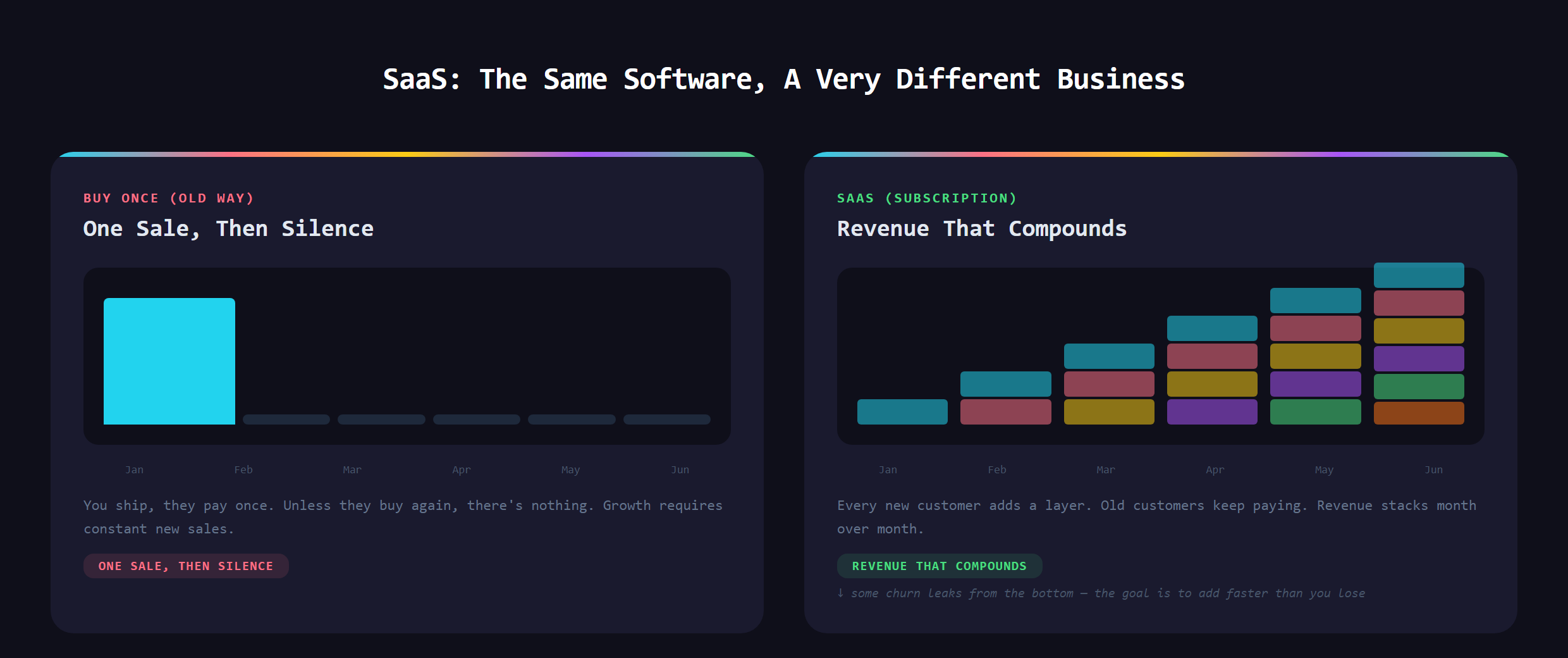
It solved a problem for both sides at once. Boxed software paid the maker exactly once and then nothing, no matter how long you used it, and customers got a product that slowly went stale. Subscriptions flipped that. The customer pays less up front and always has the latest version, and the company earns predictable, recurring revenue it can build a real business on. That alignment, both sides better off month after month, is why nearly all software quietly moved to this model.
How does SaaS actually make money?
The magic word is recurring. Instead of chasing a brand new sale every time, a SaaS earns from the same customer again and again, and those payments stack. Add a hundred customers who stay, and next month you start from that base and build on top of it. That compounding is what makes the numbers exciting. The enemy is churn, customers leaving, because it drains the stack from the bottom while you fill it from the top. The whole game is keeping people long enough that their value far outlasts what it cost to win them.
What is MRR, and why do founders obsess over it?
If you spend any time around SaaS, you will hear MRR, short for monthly recurring revenue: the predictable income the business can count on every month from its active subscriptions. Founders fixate on it because it is the truest measure of a subscription business. A one-time sale is a moment, but MRR is a baseline that either grows or shrinks each month depending on how many people join versus how many churn. Watching that one number trend up is the entire heartbeat of a healthy SaaS.
What makes a SaaS worth paying for?
Here is the rule that decides everything: the value has to recur for the payment to recur. People happily pay every month for something that keeps solving an ongoing problem (staying organized, running payroll, talking to their customers). They resent paying monthly for something they only needed once. The best SaaS products weave into a routine, so cancelling them actually hurts. That is the difference between a subscription people forget to cancel and one they drop the first slow month.
What goes wrong with a SaaS?
Most failed SaaS products share a root cause: no real ongoing value. They solve a one-time itch, so people sign up, get what they came for, and leave. Others pile on features nobody asked for instead of deepening the one outcome customers actually want. And many simply never make the thing sticky, so churn quietly eats every new signup. A SaaS is not a product you launch and walk away from. It is a relationship you maintain.
Why is this the dream build with AI?
Here is the exciting part. A real SaaS is made of building blocks you can now assemble yourself: a way to log in, a database, and recurring payments, plus an admin view to run it all. Not long ago that took a funded team. With an AI assistant in VS Code, a single person can stand one up, which is a huge part of why we teach people to Make Anything With AI.
Turning a recurring-value idea into a real subscription product, with the model and economics that make it work, is covered in Venom AI's Tier 3. SaaS is not magic. It is software plus a reason to pay again next month.