
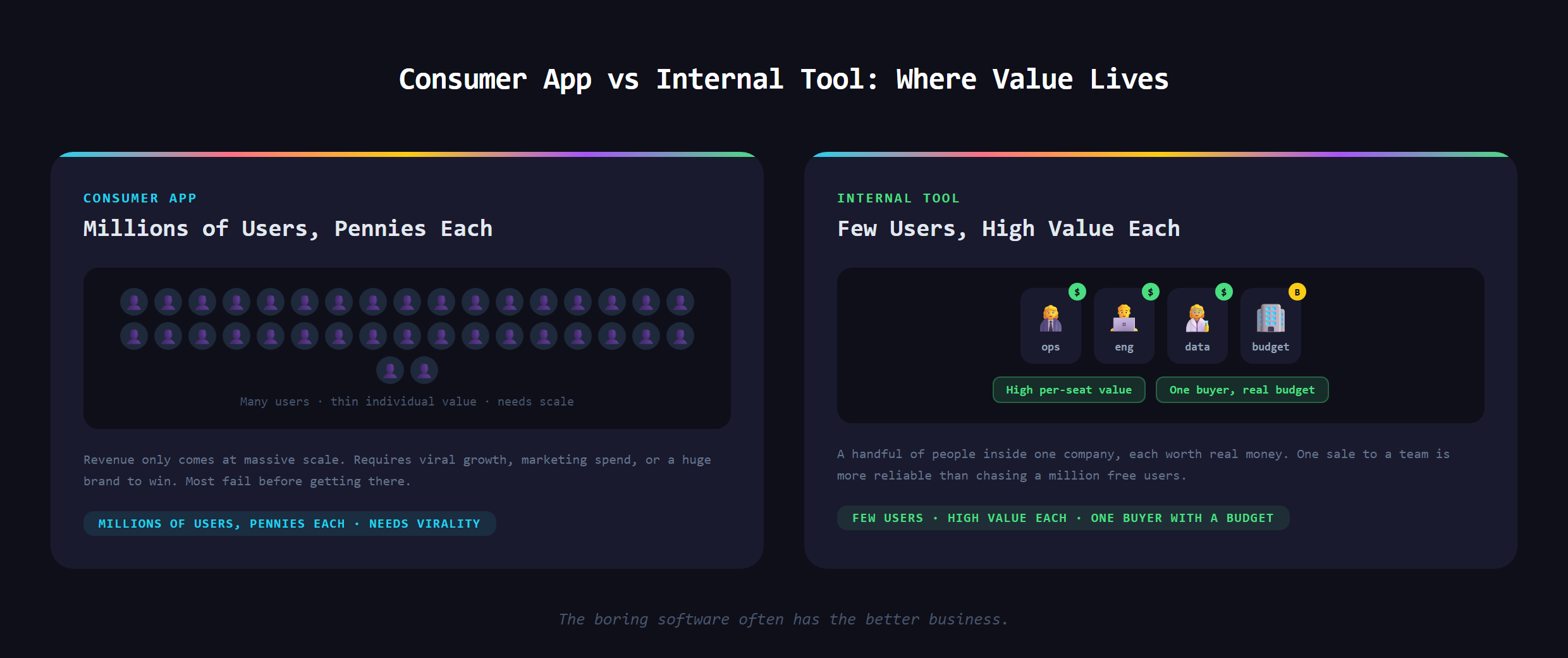
Everyone chases the flashy consumer app, the one with millions of users and a logo people recognize. Meanwhile, the boring software nobody outside a company ever sees, the stuff businesses use to run themselves, quietly pays better than almost anything. It is worth understanding why the unglamorous category is the one that prints money.
In short, an internal business tool is software a company builds, or pays to have built, for its own team rather than the public: the dashboards, admin panels, and workflow apps that run the business behind the scenes. No marketing, no virality, just a job that needs doing.
What are internal tools, really?
They are software for employees, not customers. The tool the support rep uses to find your order, the dashboard the warehouse runs on, the app the sales team lives in all day. They are rarely pretty, because they do not need to be. They exist to replace a tangle of spreadsheets, sticky notes, and manual steps with something faster and harder to get wrong. You interact with the results of internal tools constantly, even though you never lay eyes on the tools themselves.
Why do internal tools pay so well?
Because businesses pay for outcomes, not polish. A tool that saves a team hours every week, or stops a costly mistake before it happens, is worth real money to the company, and there is a clear budget to pay for it. You do not need a million users or a viral moment. You need one business with a painful problem and the means to fix it. Company budgets for solving real operational pain dwarf what an individual will ever impulse-spend on a consumer app.
Why are they the perfect first build?
Almost everything about them is forgiving. The design bar is low, because the users are paid to use the tool rather than charmed into it. The value is obvious, so you are not guessing whether anyone wants it. You do not need scale or virality, just a few happy users inside one organization. And the leads are everywhere: you almost certainly know a business limping along on a spreadsheet that should have been an app years ago. It is the unsexy on-ramp to real revenue.
What does an internal tool actually look like?
Under the hood, most of them are the same handful of pieces you have already met. A databaseof the business's data, a login with roles so the right people see the right things, forms to put data in, and an operator dashboard to see and manage it all. An internal tool is, in many ways, an admin dashboard pointed at a real-world business process.
What goes wrong building internal tools?
The number one mistake is building for yourself instead of the people who will actually use it. The warehouse team does not work the way you imagine from the outside, and a tool that ignores their real workflow gets quietly abandoned for the old spreadsheet. Others over-engineer, adding flexibility nobody asked for, or skip the unglamorous step of sitting with the actual users. The tool has to fit the work, not the other way around.
How do you find an internal tool worth building?
You look for pain that repeats. The telltale signs are everywhere once you start noticing them: a critical spreadsheet that three people email back and forth, the same data copied by hand between two systems, a process that lives only in one employee's head, or someone who burns an afternoon a week on something a simple form could do in seconds. The best internal tools do not come from a clever idea. They come from a boring, expensive, repeated chore that everyone has simply learned to tolerate.
Why is this a great AI build?
Because this kind of software (structured data, forms, dashboards, and roles) is exactly what an AI assistant is unreasonably good at producing. With one in VS Code, a single builder can deliver something that would normally be a serious custom development project, in a fraction of the time. Knowing the category exists, and how to spot the painful problem worth solving, is a big part of how Venom AI teaches you to Make Anything With AI.
Turning a business's painful spreadsheet into a real internal tool people rely on is covered in Venom AI's Tier 3. The boring software is often the best business, and it is hiding in plain sight all around you.