
A todo app seems like the most beginner-friendly thing you could build. Add a task, check it off, done. Which raises an uncomfortable question: if it is that easy, why are there a thousand of them and only a handful people actually keep using? The build is simple. Making one that sticks is the hard part, and it is not about features.
In short, a productivity app is software that captures the things you need to track (tasks, notes, habits), saves and syncs them across your devices, and presents them back in a way that helps you act. Technically simple. The difference between the winners and the graveyard is design opinion.
You have seen the easy part already: add a note on your phone and it is instantly on your laptop. That quiet sync is most of what a productivity app technically does.
What is a productivity app made of, technically?
- Storage: your tasks, notes, and entries, saved as structured data so nothing is lost.
- Sync: the same data, current on every device, often updating live.
- Accounts: so your stuff is yours and follows you, via login.
- A clear view: the interface that turns a list of records into something you actually want to open.
Honestly, none of that is exotic, which is exactly why these apps are not won or lost on the technical build.
Why does "opinionated" beat "flexible"?
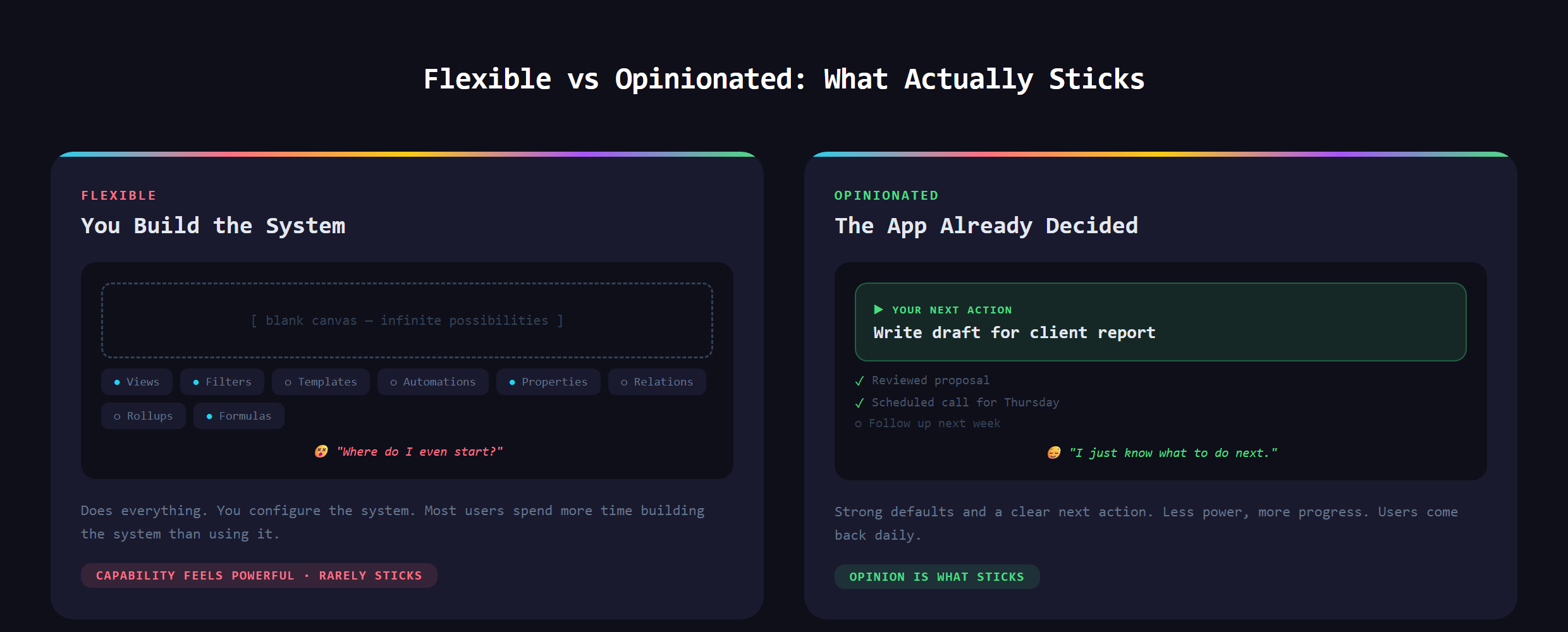
Here is the counterintuitive truth. The instinct is to make your app do everything, infinite flexibility, so it fits anyone. But a tool that can be anything forces the user to do all the deciding, and deciding is the work people came to avoid. The apps that win pick a method and bake it in: this is how you organize, here is the one way to capture, this is what matters today. That opinion is the product, and a focused, opinionated tool is one of the most satisfying things to Make Anything With AI. The everything-app feels powerful in a demo and exhausting by day three.
You have seen this play out
Think about why a focused habit tracker beats a blank spreadsheet, even though the spreadsheet can technically do more. The spreadsheet makes you design the system. The app already did. People do not pay for capability, they pay for the decisions a good app makes so they do not have to. Strong defaults beat a wall of settings every time.
How do productivity apps make money?
Usually subscriptions, because the value recurs every single day, which is exactly the kind of stickiness that makes a great SaaS. The pattern is free for the basics and paid for power features, history, or sync across more devices. The daily-habit nature is the moat: an app you open every morning is one you will never get around to cancelling.
How do you stand out in a crowded category?
Todo apps are the most crowded shelf in software, so "a better todo app" for everyone is a losing pitch. The way in is the same as the way these apps win in general, only sharper: pick a specific person and build for them. A task app designed around how nurses run a shift, how freelancers chase invoices, or how contractors juggle job sites can make bolder, more opinionated choices than any general tool, because it knows exactly who it is serving. A small, devoted audience that feels understood beats a huge one that feels catered to no one.
What makes a good one (and what kills it)?
Good: instant capture (friction is death, the thought has to land in one tap), reliable sync, and a strong opinion that does the organizing for you. Bad: a blank, do-anything canvas that makes the user build their own system, sync that loses data or lags, and feature-bloat that buries the one thing the app was great at. A productivity app is not a database with a nice skin. It is a point of view about how to get things done, and the narrower and sharper that view, the more people stick.
What goes wrong?
Most die from being too general, a flexible tool nobody has a reason to choose over what they already use. Others nail the idea but lose trust with flaky sync (the one unforgivable sin). And many keep adding until the app that was great at one thing is mediocre at ten. Pick a lane, have an opinion, and protect the one job you are best at.
Turning a sharp, opinionated productivity idea into a real app, the storage, the sync, and the design point of view that makes it stick, is covered in Venom AI's Tier 3. The plumbing is easy. The opinion is everything.