

You build a chat feature and it looks perfect. Then two people try it, and they both have to keep hitting refresh to see each other's messages. It works, technically, but it feels dead. That gap between "technically works" and "feels alive" is exactly what real-time features close.
In short, a real-time feature is anything in an app that updates the instant something changes, with no refresh and no button press, so what you see on screen is always the latest version. It is the difference between a photo of a conversation and the conversation itself.
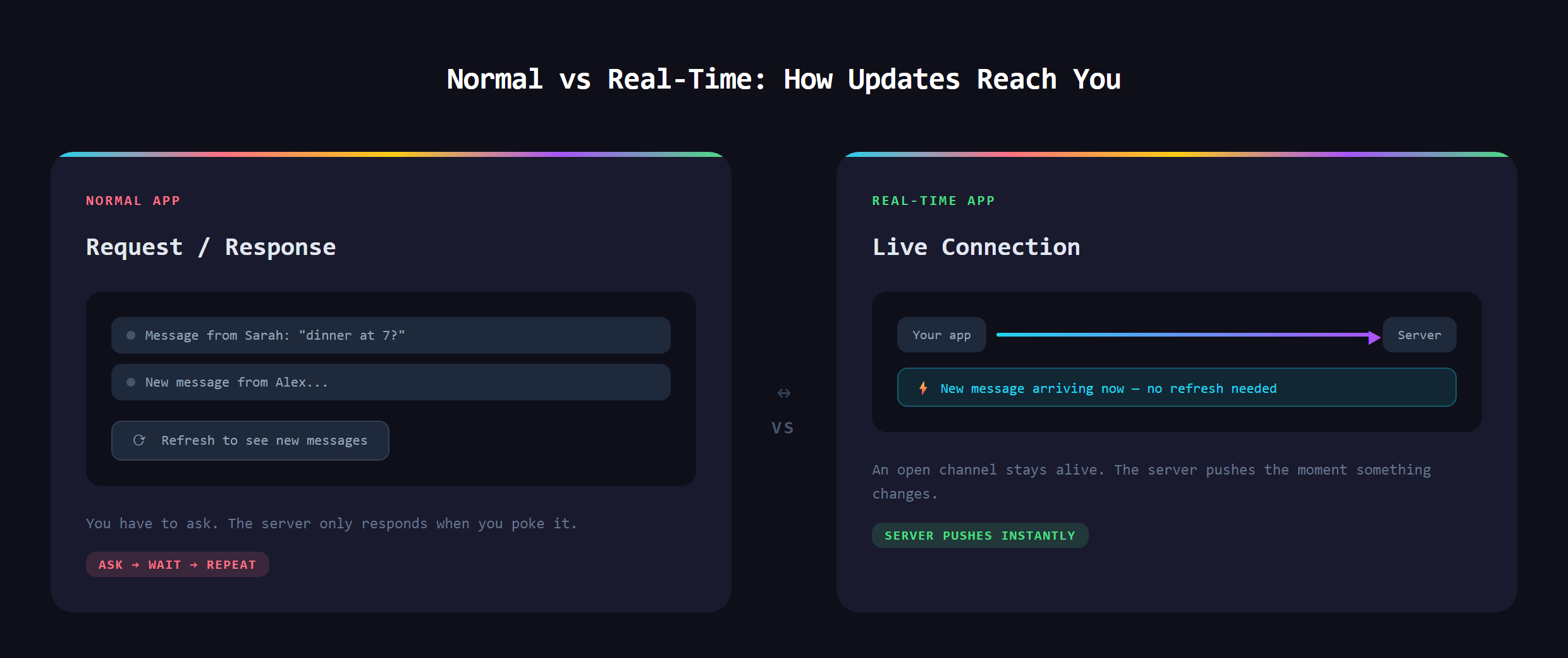
What does "real-time" actually mean?
A normal web app is built on a polite back-and-forth. The app asks the server a question ("any new messages?"), the server answers, and then nothing happens until the app asks again. Real-time flips that. Instead of asking over and over, the app opens one connection and holds it open, and the server pushes news down that line the moment there is any. You have seen this every time a typing dot appears in iMessage or a teammate's cursor glides across a Google Doc: nobody refreshed anything, the update just arrived.
What can real-time actually do?
Once an app can push instead of wait, a whole category of features opens up:
- Live chat and comments: messages land for everyone at once, no refresh.
- Presence:those little green "online now" dots, and "3 people viewing" badges.
- Typing indicators: the small signal that someone is mid-reply.
- Live dashboards: numbers and charts that tick up as events happen, no manual reload.
- Collaborative editing:two people in the same document, seeing each other's changes as they type.
- Live location: the moving car on a ride-share map.
How is it different from a normal app under the hood?
The shift is from "ask and wait" to "stay connected." A regular page fetches data once and forgets about it. A real-time page keeps a live channel open (you may hear the word WebSockets, or "subscriptions," or "listeners") so it can react the instant the data on the server moves. You do not need to know the machinery to use it, but you do need to know the concept exists, because it changes which tools you reach for.
What goes wrong without it?
Skip real-time and your app quietly feels broken in a way people cannot name. A chat where messages show up late. A dashboard that is always a little stale. A multiplayer feature where everyone is looking at a slightly different reality. The usual patch is to make the app re-ask every few seconds, which is wasteful, drains batteries, and still lags. Real updates that arrive the moment they happen are what make software feel modern.
Does everything need to be real-time?
No, and treating every feature as live is its own mistake. Real-time costs more, both in complexity and in the resources needed to hold all those connections open at once. The smart move is to spend it where liveness is the actual point: chat, collaboration, presence, live dashboards, anything two or more people share in the same moment. A blog post or a settings page does not need to update itself while you stare at it. Knowing where real-time earns its keep, and where a plain page is perfectly fine, is half of using it well, and it keeps your app fast instead of needlessly heavy.
Why is it trickier than it looks?
Holding thousands of live connections open, keeping everyone in sync, and deciding what happens when two people change the same thing at once is genuinely hard plumbing. The good news is that you no longer write that plumbing yourself. Certain databases and services handle the live connection for you, and with an AI assistant in VS Code you describe the live behavior you want and wire the right tool in. What you bring is the understanding of what real-time is and when it is worth it. That kind of clear mental model is the whole point of how Venom AI teaches people to Make Anything With AI.
Adding real-time features the right way, from live chat to presence, without drowning in connection plumbing, is covered in Venom AI's Tier 2. Once your app can update itself the instant something changes, it stops feeling like a document and starts feeling like a place.