

Someone signs up for your app at three in the morning while you are asleep. They expect a welcome email right away, and if they fumble the password, they expect a reset link that arrives in seconds. Your app has to be able to talk to people when you are nowhere near a keyboard.
In short, automated messaging is how an app sends emails, texts, and push notifications on its own, triggered by events, using a delivery service so the messages actually land instead of getting flagged as spam. It is what keeps a product alive in the gaps between visits.
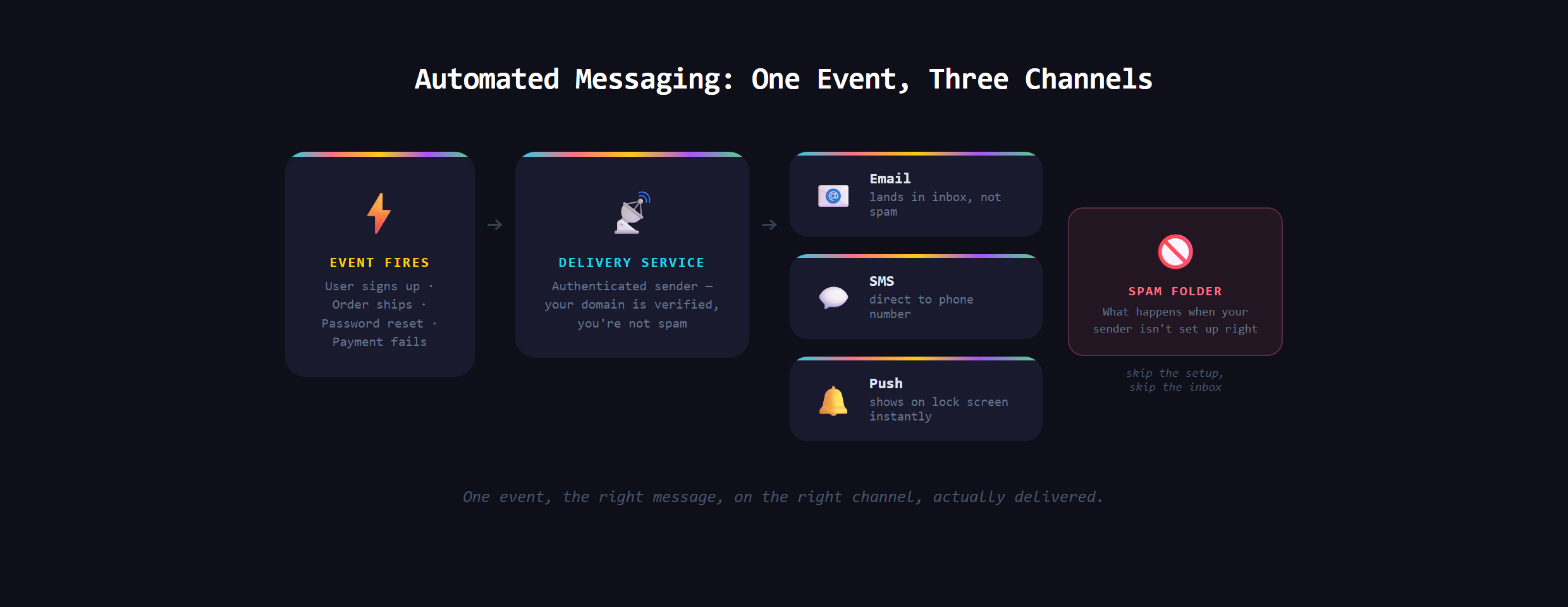
Why can't an app just send email itself?
On paper, sending an email is easy. Getting it into someone's inbox is the hard part. Mail providers are ruthless about spam, so they trust messages from established senders that have proven who they are and block the rest. A brand new app sending mail on its own looks exactly like a spammer, so its messages quietly vanish into the junk folder. That is why apps route their mail through a delivery service (Resend, SendGrid, and Postmark are common names) that carries the reputation and the technical setup needed to actually land.
What are the three channels?
An app really has three ways to reach a person, and each fits a job:
- Email: the workhorse. Receipts, welcome messages, updates, anything that does not need to be read in the next thirty seconds.
- SMS (text):for the urgent and short. Login codes, appointment reminders, "your driver is here."
- Push notifications: the banners on a phone lock screen, best for pulling someone back into an app they already installed.
Most real products use a mix, matching the channel to how urgent the message is and where the person is most likely to see it.
Transactional vs marketing: what is the difference?
This split matters more than people expect. A transactional message is triggered one to one by an action: a receipt, a password reset, a shipping update. People want these, and they almost always reach the inbox. A marketing message is a broadcast to many people at once, and it comes with legal strings attached, including a real unsubscribe link and honest sending practices. Mixing the two up is how good apps accidentally get themselves marked as spammers.
How does an app decide when to send?
Most automated messages follow one of two timing patterns. Event-triggered messages fire the instant something happens: a signup, a purchase, a password request. Scheduled messages go out on a clock instead, like a weekly digest or a gentle "you left something in your cart" nudge a day later. The real skill here is restraint. An app that pings someone for every tiny thing trains them to ignore it, or worse, to mute it for good. The best products are deliberate: they send the message that genuinely helps at the moment it actually matters, and they stay quiet the rest of the time.
What goes wrong without it (or done wrong)?
Skip automated messaging and your app feels half-finished. No confirmation after a purchase, so people wonder if it even worked. No password reset, so a forgotten password means a lost user forever. Do it badly and it is its own problem: emails that land in spam, or the opposite, an app so notification-happy that people mute it or quit. Getting the volume and the channel right is part of the craft.
Why deliverability is the real game
The quiet truth of this whole topic is that sending is trivial and arriving is everything. Landing in the inbox depends on proving your sending domain is really yours and slowly building a good reputation, which is exactly what a delivery service helps you do. You do not wire all of that by hand. With an AI assistant in VS Code you connect the right service and trigger messages from the right events, once you understand the pieces well enough to ask. That understanding is part of how Venom AI teaches people to Make Anything With AI.
Setting up automated emails, texts, and push that actually reach people is covered in Venom AI's Tier 2. Once your app can talk to its users on its own, it keeps working long after you have closed the laptop.