

You built something genuinely useful, and the exact people who need it have no idea you exist. Waiting for them to stumble onto you can take forever. Reaching out directly is faster, but do it carelessly and you come off as a spammer and torch your own reputation. There is a real way to do this, and it is a craft.
In short, cold email outreach is contacting people who have never heard of you in a way that is relevant, honest, and welcome rather than annoying. The whole game is staying on the right side of the line between a thoughtful introduction and spam.
What is cold outreach, really?
Cold simply means there is no prior relationship. The person did not sign up, did not ask, has never met you. That is different from emailing your own newsletter list, where people opted in. Cold outreach is the digital version of a sharp, well-targeted introduction, not a megaphone pointed at a crowd.
You have seen the bad version: the generic "Hi {first_name}, quick question" that obviously went to ten thousand strangers. You have also, probably without noticing, gotten the good version: a short, specific note from someone who clearly knew who you were and had a real reason to write. Same channel, opposite outcomes.
What actually makes it work or fail?
Three forces decide whether cold outreach lands or backfires, and it is worth knowing all three before you send anything:
- Relevance: a small, well-chosen list of people who plausibly care beats a huge list of strangers every single time.
- Deliverability: whether your message even reaches the inbox, which depends on how your sending domain is set up and how carefully you ramp up volume.
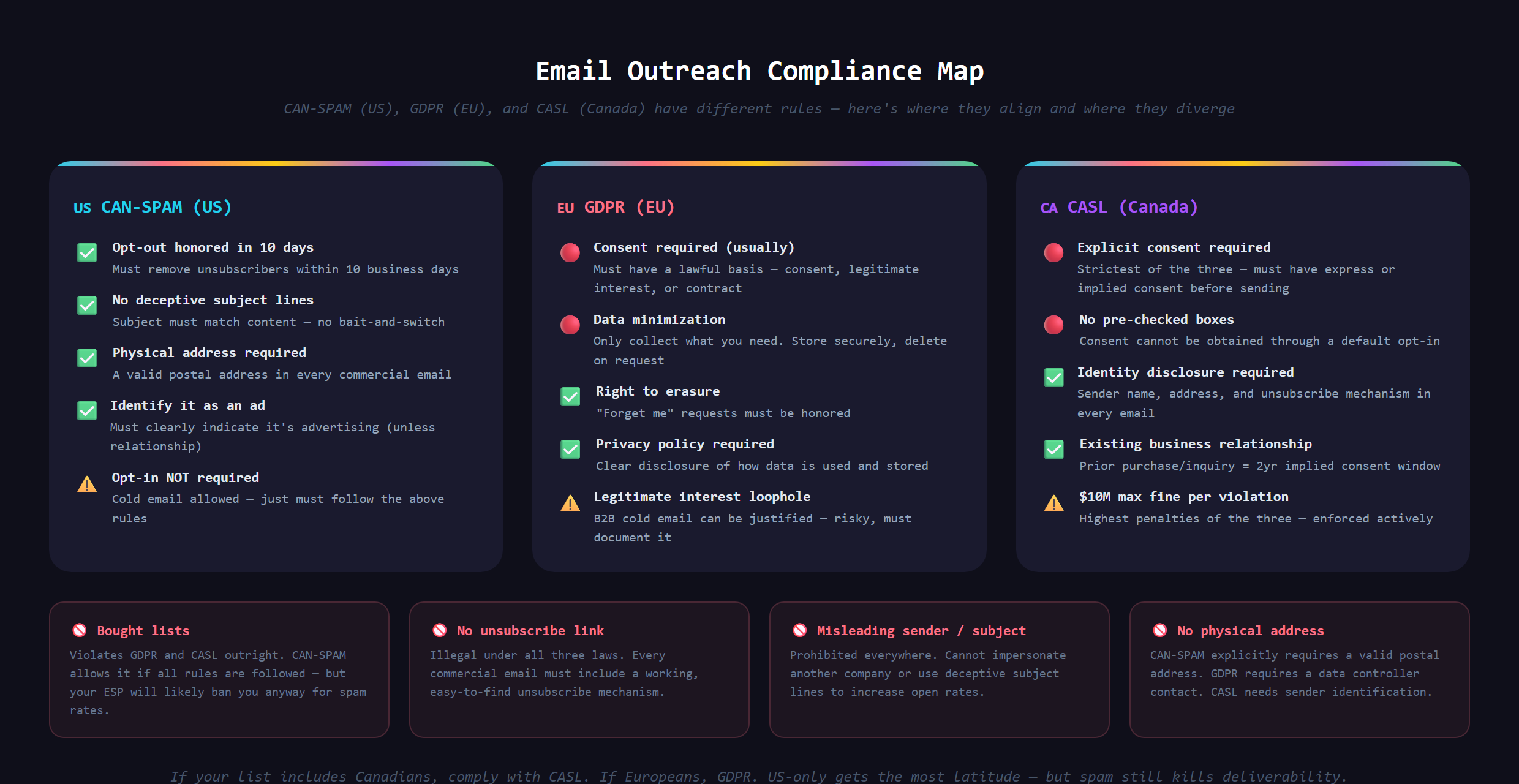
- Compliance: the actual laws about who you may contact, what you must disclose, and the opt-out you must always provide.
Most people obsess over what to write and ignore these three. That is backwards. A perfect message sent from a misconfigured domain to the wrong people lands in spam and accomplishes nothing.
What is deliverability and why does it rule everything?
Inbox providers like Gmail and Outlook are constantly judging whether your mail is wanted. They look at how your domain proves it is really you, how fast you send, and how people react. Get this wrong and your messages are quietly filed in spam where no human will ever see them.
This is why serious senders treat their domain reputation like a credit score: slow to build, easy to wreck, and worth protecting. The single fastest way to destroy it is to blast a huge list before you have earned any trust. Reputation, not cleverness, is what gets you read.
Where is the legal and ethical line?
This is the part people skip and regret. Business-to-business cold email is legal in many places when you are honest about who you are, keep it relevant, and give an easy opt-out. But the rules vary sharply by country, and some are far stricter than others.
The ethical line is simpler than the legal one: would this email be a welcome surprise to the person getting it, or an intrusion? Build your outreach so the answer is the first one and you will rarely find yourself near the second. Personalizing at scale without crossing into spam is the skill, and yes, AI can help reach many people while keeping each note genuinely specific. That is a power tool that cuts both ways.
Where does this fit in growing what you build?
Cold outreach is the active counterpart to the patient pull of SEO. SEO waits for the right people to come to you. Outreach goes and finds the first ones before the search traffic exists. For a brand-new product with zero audience, that head start can be the difference between momentum and silence. It pairs closely with how apps send email at all.
The actual setup, the domain configuration, the deliverability discipline, and the responsible workflow for personalized outreach, is covered in Venom AI's Tier 4, part of how we teach you to Make Anything With AI. Done right, this is one of the most direct ways to put what you built in front of the people who need it.