

Most AI is reactive. You open it, you ask, it answers, it goes quiet until you come back. That is useful, but it means nothing happens unless you are sitting there to make it happen. The best automation is the kind you forget about, the work that gets done while you are doing something else entirely, or nothing at all.
In short, a scheduled AI agent is an AI agent that runs on a timer you set in advance, instead of waiting for you to ask. It wakes up on its own schedule, does its job, and leaves the result for you, often while you sleep.
You have lived alongside scheduled jobs for years without thinking about them. The way your phone backs up overnight, the way a newsletter lands in your inbox at the same time each morning, the way your bill auto-pays on the first: all of that is something running on a clock, no human pressing go. A scheduled agent is that idea, but the worker is an AI.
How is this different from a regular AI agent?
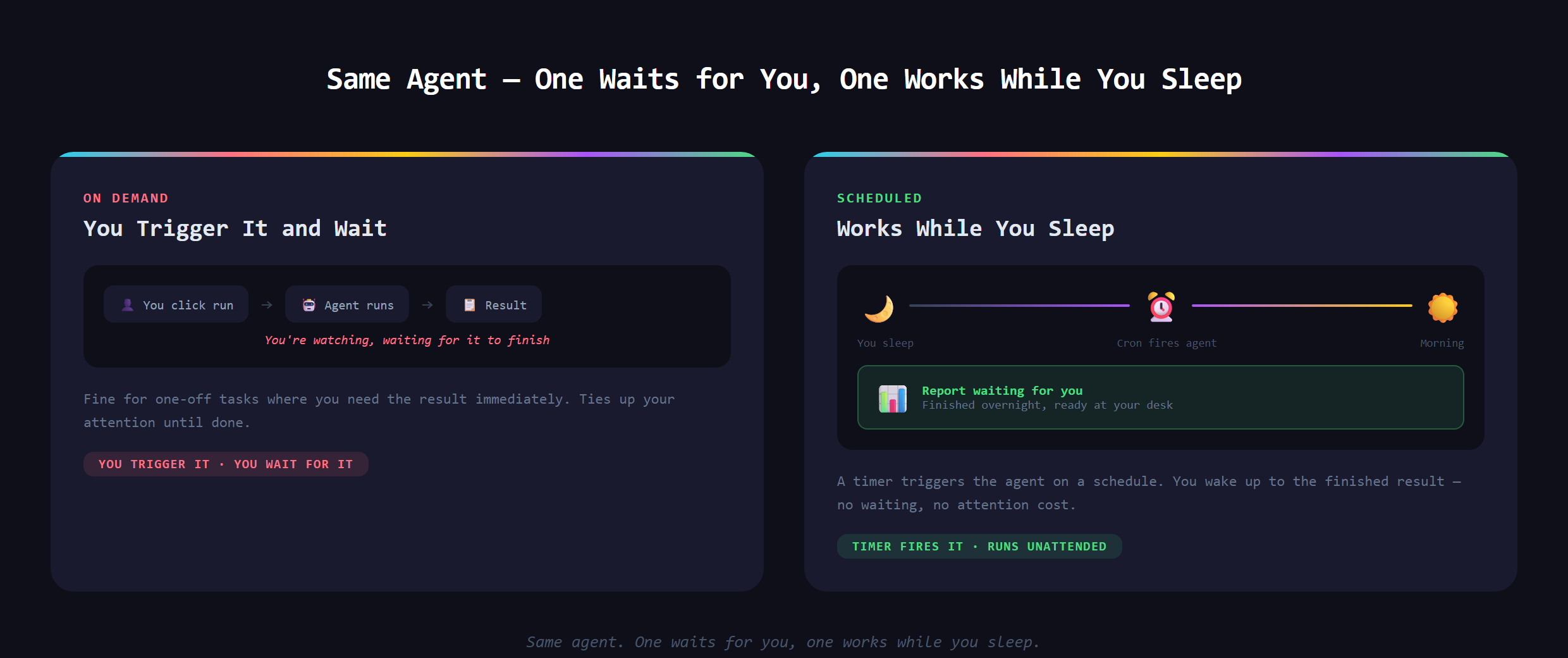
It is the same machine with a different starter button. A regular AI agent is a model plus tools plus a loop, set in motion when you give it a goal. A scheduled agent is that exact same thing, except the trigger is a clock rather than you. You define the job once and define when it should run, and from then on time pulls the trigger for you. Nothing about the agent changes. Only what wakes it up.
What does "works while you sleep" really mean?
The phrase sounds like marketing, but it is literal. Plenty of useful work is recurring and does not need you present: scanning overnight for a problem, pulling together a summary before you wake, watching a source and flagging anything new. A scheduled agent handles those on its own clock, so the value is sitting there when you open your laptop. You traded doing the task for setting it up once.
Why does it need an always-on home?
A timer is useless if the worker is asleep too. For an agent to fire at 3 a.m., something has to be awake at 3 a.m. to run it, and that something is not your closed laptop. Scheduled agents live on an always-on server, the same kind of always-on machine behind web hosting, which is why understanding where your code lives and runs matters here. The agent running independently of your own computer is the whole point.
What can you actually automate this way?
The sweet spot is any repeating job with a predictable shape. A daily digest of your email or the headlines that matter to you. A nightly health check that something you run is still working, with an alert only if it is not. A weekly report stitched together from a few sources. Routine monitoring that would be tedious to babysit. The test is simple: if you would set yourself a recurring reminder to do it, an agent can probably do it for you instead.
Where do scheduled agents fit in the bigger picture?
This is one of the most practical shapes in modern AI building. It takes the agent pattern and adds the one ingredient that turns a tool you operate into a tool that operates itself. Pair it with a knowledge base through RAG and it can produce informed summaries on a schedule. Point several at once at a bigger job and you are edging toward a multi-agent system. Scheduling is the small step that makes the rest run on autopilot.
What goes wrong without it?
Without scheduling, every useful automation still has a human bottleneck: you. The summary only happens if you remember to ask for it. The check only runs if you run it. Recurring work that should be effortless quietly becomes one more thing on your list. Worse, an unattended job with no guardrails can also misfire on a timer, which is why setting clear limits matters as much as setting the clock.
Building scheduled and overnight agents, the agent, the timer, and the always-on home that runs them, is covered in Venom AI's Tier 4, part of how we teach you to Make Anything With AI. Set the work up once, and let the clock do the rest.