

Some of the most tedious work online lives on websites that simply do not want to talk to your code. There is no clean connection to plug into, no official doorway, just a page built for a human with a mouse. So the obvious question becomes: what if the AI just used the website the same way a person does?
In short, AI browser automation is an AI driving a real web browser: opening pages, reading what is on them, clicking buttons, typing into boxes, and filling out forms, all on its own. It uses a website the way you would, instead of needing a special connection.
You have watched a version of this already. Those screen recordings where a cursor moves by itself, clicks through a checkout, and fills a form with no hand on the mouse: that is browser automation. The new part is an AI deciding what to click, rather than a fixed script doing the same motions every time.
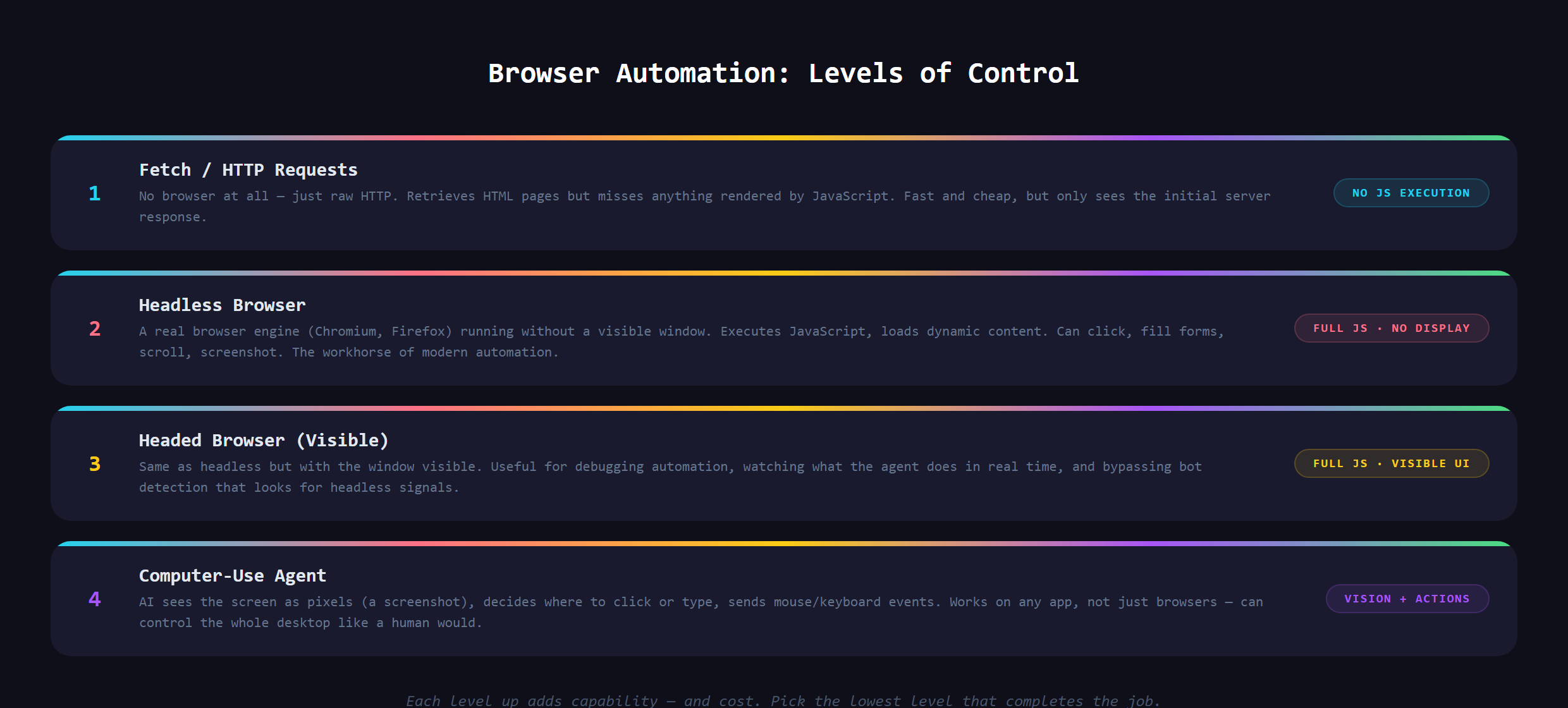
Why does browser automation exist at all?
The clean way for programs to talk to a service is through an API, an official doorway built for exactly that. But not everything has one. Plenty of useful sites offer no API, or lock theirs behind approval, or simply never built one. When there is no doorway, you go through the front door the humans use: the website itself. Browser automation is the technique for working with the web as it actually is, not as you wish it were.
How does an AI "see" a web page?
This is the part the AI makes new. A page is just structured content under the hood, and the automation can read that structure, the text, the buttons, the input fields, to understand what is in front of it. The AI looks at that, reasons about what it is trying to accomplish, and decides the next action: click here, type there, go to that link. Then it does it, looks at the new page, and decides again. If that loop sounds familiar, it should: it is an AI agent whose main tool happens to be a browser.
What can AI browser automation actually do?
The practical wins are the repetitive web chores that eat real time. Gathering the same information off a set of pages on a regular basis. Filling out the same kind of form over and over. Checking a site for a change and reacting when it happens. Walking through a routine multi-step flow that you would otherwise click through by hand. Anywhere the work is "do this same thing on the web again and again," automation is a natural fit.
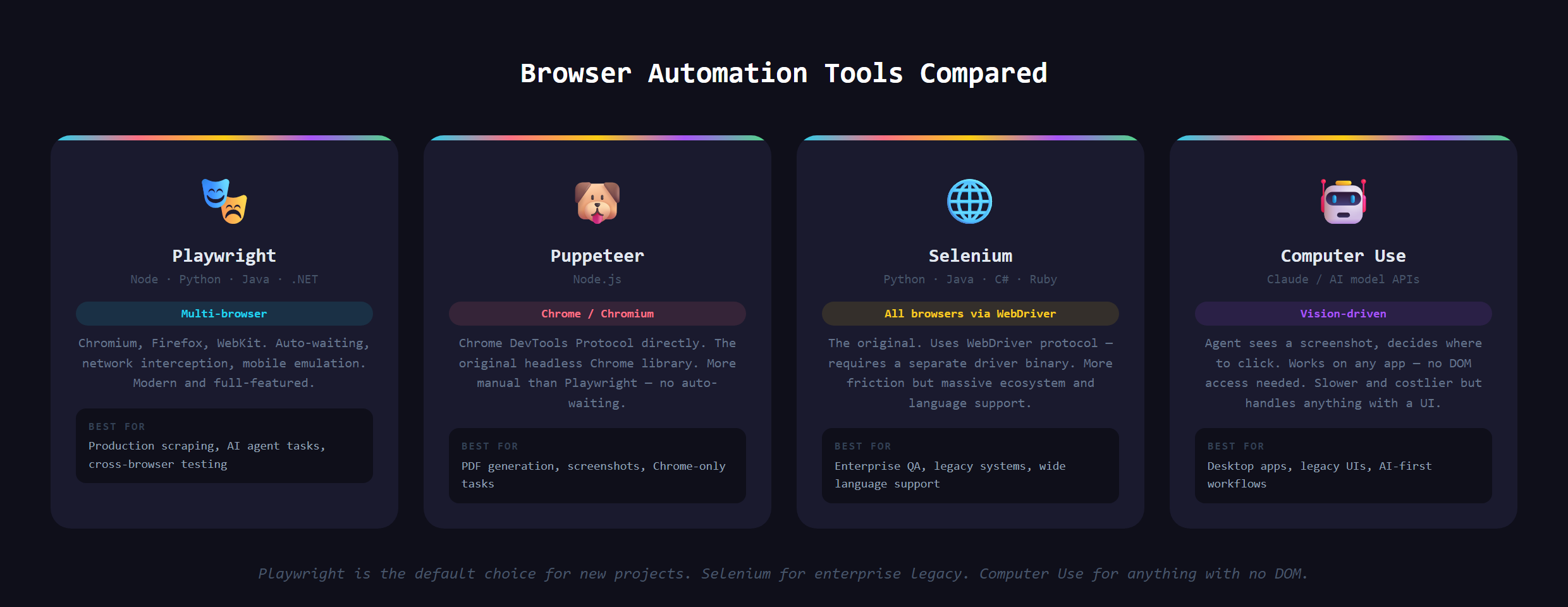
Why is it so fragile?
Here is the honest tradeoff. Because browser automation depends on the visible layout of a page, it breaks when that layout changes. A site redesign, a moved button, a renamed field, and the automation can stop cold. On top of that, many sites actively try to detect and block automated visitors, which turns the whole thing into a cat-and-mouse game. AI reading the page makes automation smarter and more adaptable than the old rigid scripts, but it does not make the underlying ground stop shifting. Always prefer a real API when one exists; reach for the browser when one does not.
Where does it fit in the bigger picture?
Browser automation is one of the headline powers of modern AI agents, because it lets them act on the open web, not just on services that opened a door for them. Put it on a timer as a scheduled agent and it can run a web chore every night untouched. It is the tool that lets an AI reach the parts of the internet nothing else can.
Building AI browser automation, the agent, the browser as its tool, and the judgment to use it where it actually fits, is covered in Venom AI's Tier 4, part of how we teach you to Make Anything With AI. Once an AI can use a browser, the whole web becomes something you can automate.