

"AI agent" might be the most over-hyped phrase in tech right now, and also one of the least clearly explained. Everyone is building agents, selling agents, worried about agents. But ask what one actually is and you get fog. The real answer is refreshingly simple, and once you see it you cannot unsee it.
In short, an AI agent is an AI model that can take actions, not just produce text: it uses tools, reads the results, and decides its next step on its own, repeating until the task is finished. A chatbot answers. An agent does.
You have seen the difference if you have used an AI coding assistant that does not just suggest code but actually opens files, runs the project, reads the error, and fixes it. That do-then-check-then-do-again behavior is an agent at work.
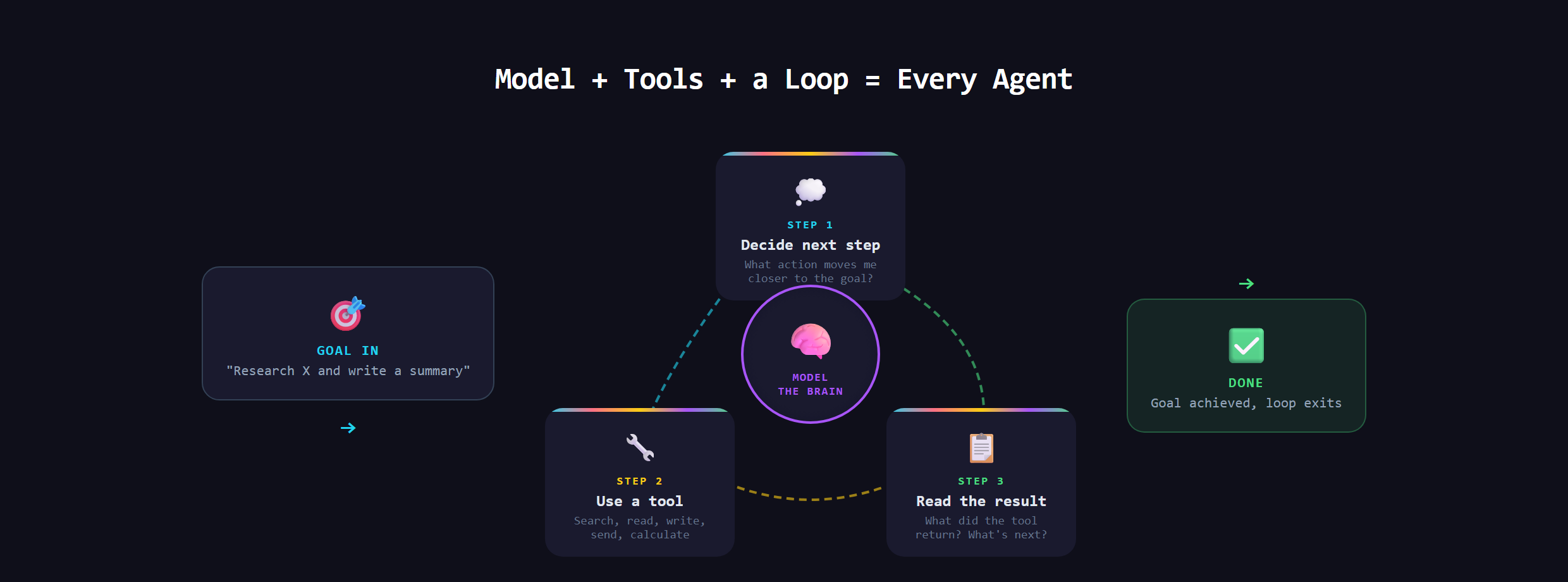
What separates an agent from a chatbot?
A chatbot is a conversation: you talk, it replies, and the loop is you. An agent moves the loop inside the AI. You give it a goal, and it decides what to do, does it, looks at what happened, and decides again, without you driving each step. The chatbot needs you in the seat. The agent takes the wheel for a stretch and reports back. That shift, from answering to acting, is the entire idea.
What is the one pattern behind every agent?
Here is the part that demystifies the whole field. Under all the branding, every agent is the same three ingredients:
- A model: the brain that decides what to do.
- Tools: the things it can actually do (search the web, read a file, send a message, call a service).
- A loop: do something, see the result, decide the next thing, repeat until done.
That is it. A research agent, a coding agent, a customer-service agent, they are all that same model-tools-loop pattern pointed at different jobs with different tools. Once you understand the loop, agents stop being magic.
What are "tools," really?
Tools are how an agent reaches out of the chat box and touches the real world. Left alone, a model can only produce words. Give it tools and it can look things up, change a file, hit a service, or trigger an action. The model does not run the tool itself: it asks for the tool, your system runs it, and the result comes back for the model to react to. Giving an AI safe, standardized access to real tools is its own subject, and the whole point of an MCP server.
Where do agents shine, and where do they flail?
Agents earn their keep on multi-step tasks you would otherwise babysit: research across many sources, work that loops until a check passes, jobs that react to whatever they find. The reason they feel like magic is the loop, the AI catching its own mistakes and trying again without you. But the same autonomy that makes them powerful makes them risky. An agent let loose with the wrong tools, or no limits, can confidently do the wrong thing many times, fast. The skill is giving an agent exactly the tools it needs, clear boundaries, and a way to stop.
Why is this the exciting frontier?
This is where building with AI gets genuinely powerful. A simple app answers when asked. An agent can be handed a goal and left to work, which is a different category of useful, and far more achievable than the hype makes it sound, because the underlying pattern is so simple. That accessibility, real capability from a simple pattern, is exactly what Make Anything With AI is about.
What goes wrong?
The classic mistakes: handing an agent too many tools so it gets confused about which to use, giving it no limits so a loop runs away, or reaching for an agent when a single AI answer would have done the job. Not everything needs to be an agent. The art is knowing when the loop earns its complexity and when a plain request is plenty.
Building your own AI agent, the model, the tools, and the loop that ties them together, is covered in Venom AI's Tier 4. Learn the one pattern, and every agent you will ever meet suddenly makes sense.