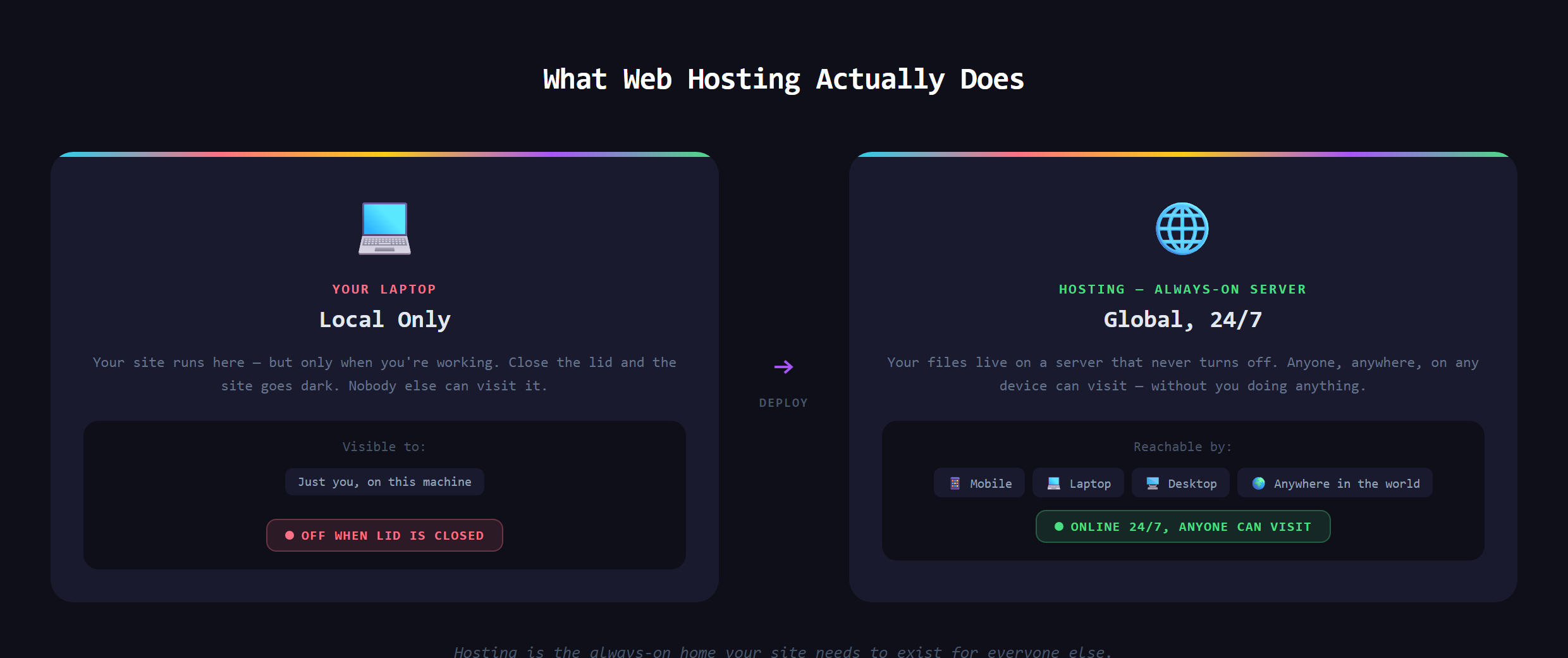
Your site works perfectly. The catch is that it only works on your laptop. Close the lid and it vanishes from the world, because the only copy lives on your machine and nobody else can reach it. So how does a site get from your computer to a real address that anyone, anywhere, can visit?
In short, web hosting is renting space on a computer that stays on around the clock (a server) so your site lives on the public internet instead of only on your laptop. It is the difference between a thing you can show a friend over your shoulder and a thing the whole world can open.
What is web hosting, really?
A host is just a computer whose entire job is to stay on, stay connected, and hand your site to anyone who asks for it. That is why a website loads instantly at three in the morning: a server somewhere never sleeps. You could in theory run all of this from your own laptop, but you would have to leave it powered on and online forever, which is exactly the chore hosting takes off your hands.
What is the difference between hosting and a domain?
This trips up almost everyone at first. Hosting is the land and the house: the always-on computer where your site actually lives. A custom domain is the street address: the memorable name people type to find it. You need both, and they are usually bought separately. Hosting with no domain leaves you at an ugly auto-generated address that works but feels temporary. A domain with no hosting is an address pointing at an empty lot. Wire the two together and people can both find your site and load it. It is the same split behind every website you visit, where one service often handles the address and another handles the home, joined once and then forgotten.
How do you choose a platform?
There is no single best host, only the right fit for what you are building. The landscape sorts roughly into three lanes:
- Modern sites and web apps: deploy-with-a-command platforms make going live almost effortless and scale for you. Great for most projects.
- Apps that need a backend bundled in: services like Firebase pair hosting with a database and logins, so it all lives in one place.
- Full control: running your own server gives you the most power and the most responsibility. It is a deeper path, worth it once you genuinely need it.
What should you actually care about when choosing?
A few things matter more than the brand name. How easy is it to deploy, so going live is not a weekend ordeal. Does it scale, so a sudden rush of visitors does not knock you over. What does it cost as you grow, not just on day one. And does it fit your stack, so you are working with the platform instead of fighting it. Get those right and hosting becomes invisible, which is exactly what you want. And you are rarely locked in: most sites can move to a different host later if you outgrow the first one, so picking a sensible starting point matters more than picking a perfect one.
Where does hosting fit when you launch?
Hosting is one piece of going live, not the whole thing. It puts your site on a server, then a custom domain points a memorable address at it, and a final round of launch polish gets it ready for real visitors. Together those three turn a project on your laptop into something genuinely live.
What goes wrong if you pick wrong?
Choose a host that does not match your project and you feel it fast. You overpay for power you do not need, or you outgrow a platform that cannot scale, or you sink hours wrestling complexity that a simpler choice would have erased. The good news is that with an AI assistant in VS Code you do not have to memorize every option. You need to understand the lanes well enough to pick the right one, which is part of how Venom AI teaches you to Make Anything With AI.
Choosing a host and getting your app live on it the right way is covered in Venom AI's Tier 2. Once your site lives on an always-on server, it finally exists for everyone, not just for you.