Your site is live, which feels great until you try to tell someone where it is. The address is a long string of auto-generated characters nobody could remember or type, and the moment you say it out loud it sounds like a test project, not a business. That gap, between "it exists" and "it feels real and people can find it," is what a custom domain closes.
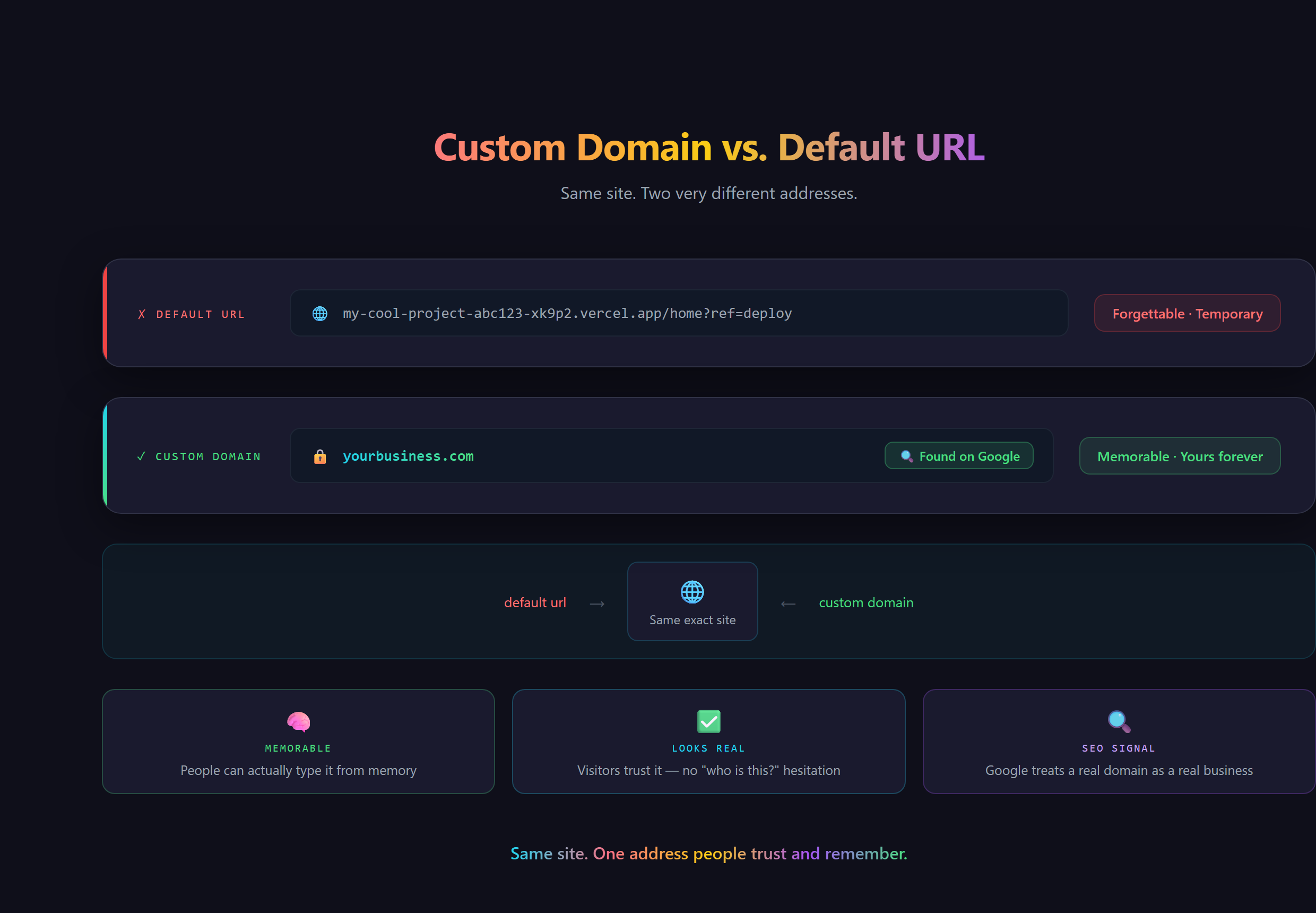
In short, a custom domain is your own web address, like yoursite.com, that you own and point at your site, replacing the long default URL with something short, memorable, and unmistakably yours.
Your address is also your identity
A domain does two jobs at once. It is the address people type to reach you, and it is your identity on the internet. When your site lives at your own name, every email, business card, and link reinforces one memorable place. When it lives at a borrowed auto-generated URL, you look like you are renting a corner of someone else's platform, because you are. Owning your domain is the difference between having an address and squatting at one.
You have read this signal a thousand times as a customer. A real company has its own .com. The second a link is some random sub-address of a platform you have never heard of, a little alarm goes off and trust drops. Your visitors run that same check on you in a fraction of a second.
How a domain actually connects to your site
At a high level, a domain is a friendly name that points to where your site actually lives. The internet has a kind of phonebook that translates your memorable name into the technical location of your site, so when someone types your address, they land in the right place. You do not need to understand the plumbing to use it. You register the name, point it at your site, and from then on that name is yours. The point is the result: one clean address you control.
This sits right alongside the other launch pieces. Your site needs a place to live, which is the job of a backend and host like Firebase, and your domain is the front door people walk through to reach it. Different jobs, same goal of getting a real site in front of real people.
Getting found: the part most people skip
Having a domain is step one. Being found at it is step two, and it is the one people forget. Search engines do not magically know your site exists the moment it goes live. You can tell them, using a free tool called Google Search Console that lets you submit your site, confirm it is yours, and watch how it shows up in search results over time. Your domain is the stable identity all of that reputation attaches to, which is why getting the domain right early pays off for years. This findability work is part of what we cover at Venom AI, because a great site nobody can find is a tree falling in an empty forest.
What goes wrong without one
Stay on the default URL and you pay quietly. The address is impossible to share or remember, so word of mouth dies on contact. You look unfinished, so trust never gets off the ground. And because you have not claimed and registered your site with the search engines, you stay invisible to the people googling for exactly what you offer. The site can be excellent and still be a secret.
How to get your own custom domain, point it at your site, and register it with Google Search Console so people actually find you, is walked through step by step in Venom AI's Tier 1. It is one of the final pieces that takes a project from "built" to a real presence, and a key part of how you Make Anything With AI that the world can actually reach. For the full pre-launch pass, see the website launch checklist.