

You launched something good and almost nobody can find it. Running ads forever is exhausting and expensive, so the dream is simple: people searching for what you built quietly discover it on their own. That is what SEO is supposed to do, and the playbook for it looks very different now than it did a few years ago.
In short, SEO in 2026 is the practice of being the clearest, most trustworthy answer to a real question, so that both search engines and AI answer engines confidently send people to you. The old tricks are dead. The substance is everything.
What actually changed?
For years SEO had a seedy reputation, and it earned it. People stuffed pages with keywords, bought piles of cheap links, and spun out thin articles to game the system. Google spent the last decade systematically killing every one of those shortcuts.
Then the bigger shift arrived: people stopped only typing into a search box. They started asking ChatGPT, Perplexity, and the AI summaries baked into search itself. You have seen this every time an AI hands you a direct answer with a few sources underneath instead of ten blue links. Those sources are the new front page, and getting cited there is the new game.
What does SEO rest on now?
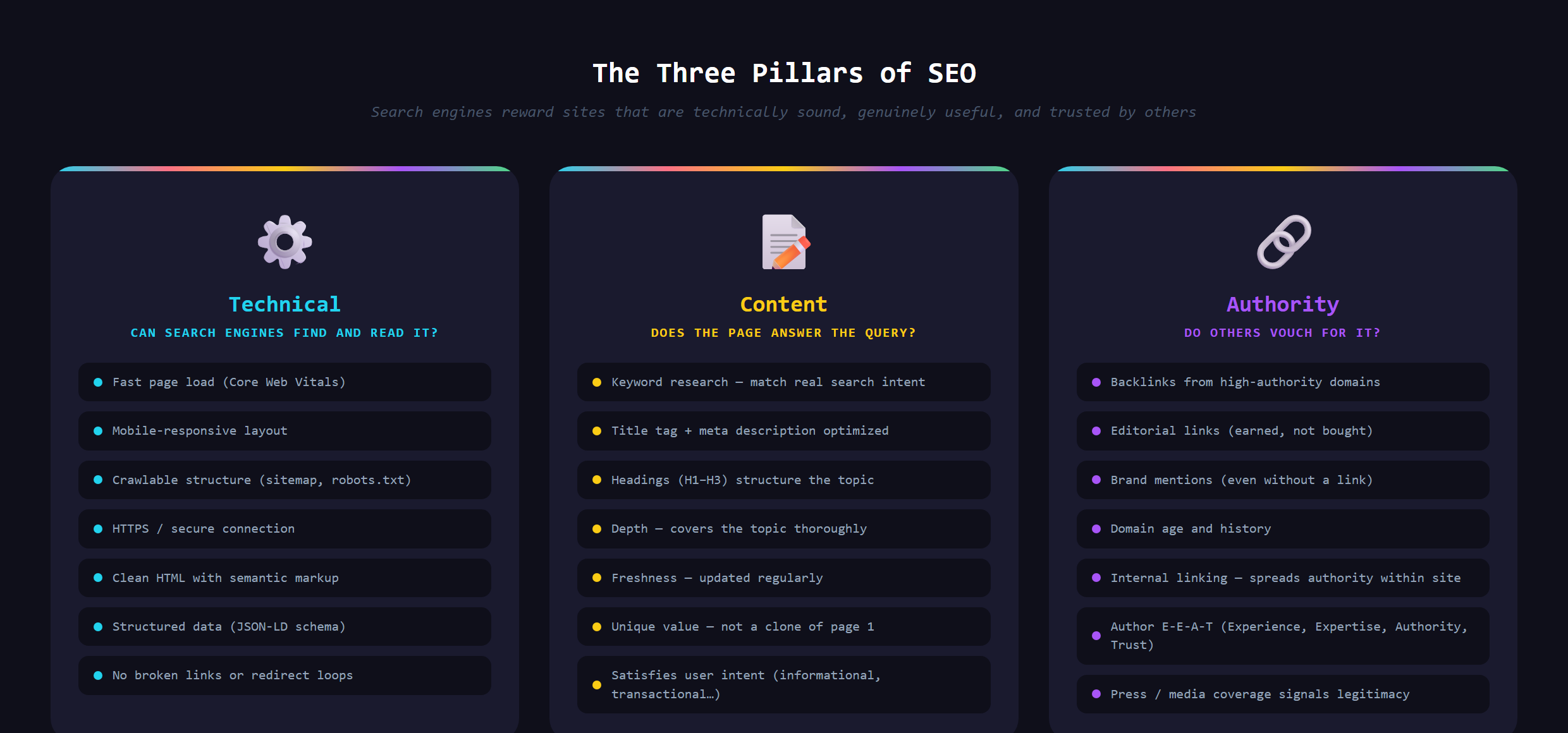
Strip away the noise and modern SEO stands on three plain pillars:
- Genuinely helpful content: pages that answer a real question better than the alternatives, written for a human first.
- Technical health: a site that loads fast, works on a phone, and is easy for a crawler to read and understand.
- Earned authority: other credible places referencing you, which is now earned by being worth referencing, not bought.
Notice what is missing: clever tricks. The whole point in 2026 is that the trick is to actually be good. These very guide pages are that principle in action: helpful explainers that earn their ranking instead of begging for it.
What is this GEO thing everyone mentions?
GEO, generative engine optimization, is just SEO pointed at the AI answer engines. The reassuring part is that it is not a separate skill. The same clear, well-structured, trustworthy page that ranks in Google is exactly what an AI model reaches for when it builds an answer.
Clean structure, honest information, a real question answered plainly: that is what gets you quoted by a machine and ranked by a search engine at the same time. One body of work, two doors it opens. It pairs naturally with a strong custom domain and the launch basics that let a site get crawled in the first place.
What goes wrong if you chase the old playbook?
People still buy the 2018 advice. They cram keywords until the writing reads like a robot, pay for link packages, and pump out generic AI articles by the hundred. In 2026 every one of those moves can actively sink a site, because the engines are tuned to spot exactly that pattern and bury it.
The other quiet failure is impatience. SEO is a compounding asset, not an instant one. Treat it like an ad campaign you expect to convert this week and you will quit right before the slow curve finally bends upward.
Why is SEO worth the patience?
Ads stop the moment you stop paying. A page that ranks keeps bringing people in for free, month after month, long after you wrote it. For a builder shipping with AI, that is the difference between renting your traffic and owning it. It is the slowest channel to start and the cheapest one to keep.
Building the actual content engine behind this, the structure, the technical setup, and the workflow that turns one good page into many, is covered in Venom AI's Tier 4, part of how we teach you to Make Anything With AI. The era of gaming search is over. The era of deserving it is wide open.