

You write something genuinely useful. People read it. It maybe even ranks. And then the obvious question lands: how does any of this turn into a business? Plenty of sites pull real traffic and earn almost nothing, while smaller ones quietly print money. The difference is never the writing alone.
In short, a content site is a business that turns published words (articles, guides, reviews, videos) into money, usually through some blend of advertising, paid subscriptions, a newsletter, and affiliate commissions. The content is the product, and the audience is the asset.
You have seen this happen mid-sentence: a news article lets you read two paragraphs, then fades into a "subscribe to keep reading" wall. That is a content business choosing its model on you in real time.
What actually is a content site?
Strip away the design and a content site is two machines bolted together. One is the publishing machine: a place to write, store, and serve articles at a real web address. The other is the money machine: the layer that turns attention into revenue. Most beginners build the first and forget the second, which is exactly why so many beautiful blogs earn nothing.
How do content sites actually make money?
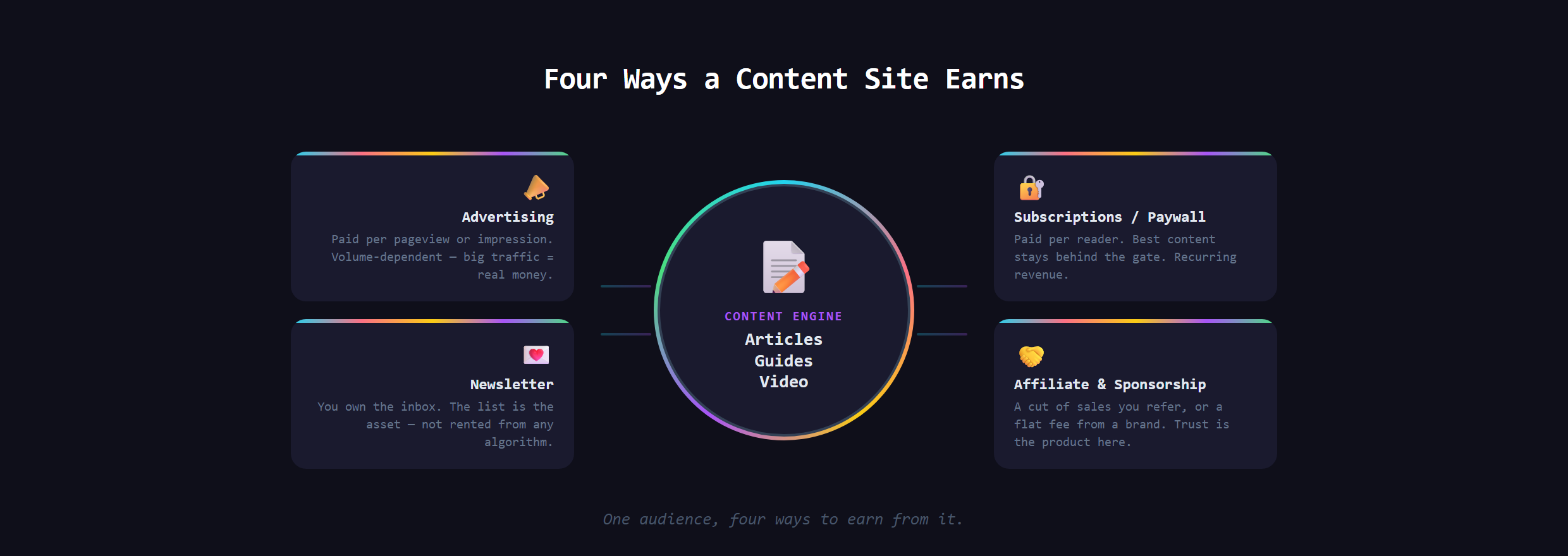
There are really only four levers, and serious sites pull more than one:
- Advertising: you sell space on the page. It pays per view, so it rewards raw volume and rewards it thinly.
- Subscriptions and paywalls: readers pay for access. Far fewer readers, far more money per reader. It is recurring revenue, the same engine that powers a SaaS business.
- Newsletters: you reach readers directly in their inbox, where you can sell, recommend, or simply keep them coming back.
- Affiliate and sponsorship: you recommend a product, and earn a cut when a reader buys or a brand pays to be featured.
The healthiest sites stack these. A free article earns ad money, feeds the newsletter, and points a few readers at a paid tier. No single lever carries the whole thing, which is the mistake that sinks most first attempts.
Why is the newsletter the secret weapon?
Search traffic and social traffic are rented. Google changes its mind, a platform tweaks its feed, and an audience you spent years building can evaporate overnight. An email list is the one channel you own outright. When you can reach ten thousand interested people directly, you are no longer at the mercy of an algorithm. That is why nearly every smart publisher treats the newsletter as the real product and the website as the funnel into it. The plumbing for that, automated emails that actually land in the inbox, is its own skill.
Where does SEO fit?
SEO is how strangers find you for free. Someone types a question, your page answers it completely, and you earn a visitor who cost nothing to acquire. (You are reading a page right now that exists for exactly that reason. This is Make Anything With AI's own content layer doing its job.) The catch: ranking is a long game and the ground keeps shifting, so a site that lives or dies on search alone is fragile. SEO fills the top of the funnel. The newsletter and the paywall are what keep the value once it arrives.
What makes a good content site versus a doorway?
The line is value. A good content site answers a real question and leaves the reader better off, which is exactly what both Google and AI answer engines now reward. A bad one is a thin doorway stuffed with keywords and ads, built to be clicked once and never again. The first compounds: every article keeps pulling traffic and feeding the list for years. The second decays the moment the algorithm notices. Tools help you publish faster, but they cannot fake being useful.
What goes wrong?
The classic failure is building the publishing machine and skipping the money machine entirely: a gorgeous site, real readers, and no plan to capture any of it. The second is renting your whole audience from one platform and getting erased by a single algorithm change. The third is chasing volume over trust, piling on cheap posts until the site reads like spam and the loyal readers quietly leave. A content site is not a pile of articles. It is an audience you earn, and a handful of ways to serve them that happen to pay.
Turning a publication into an actual business, the publishing engine, the paywall, the newsletter, and the SEO that feeds them, is covered in Venom AI's Tier 3. The writing gets you readers. The model is what turns readers into a living.