
You know something worth teaching. Putting a few videos online sounds easy enough. Then the real questions arrive: how do you stop a paying student from sharing the link, how do you know who finished lesson three, and how do you make someone feel like they are getting somewhere instead of staring at a folder of files. That is the platform, and it is far more than a video player.
In short, an online course platform is software that hosts lessons, controls who can access them, tracks each student's progress, and marks completion. It turns a pile of videos into a structured learning experience people will pay for.
You have seen this anchor every time a site like Coursera or Udemy remembers exactly which lesson you left off on and unlocks the next one. That is enrollment and progress tracking working together.
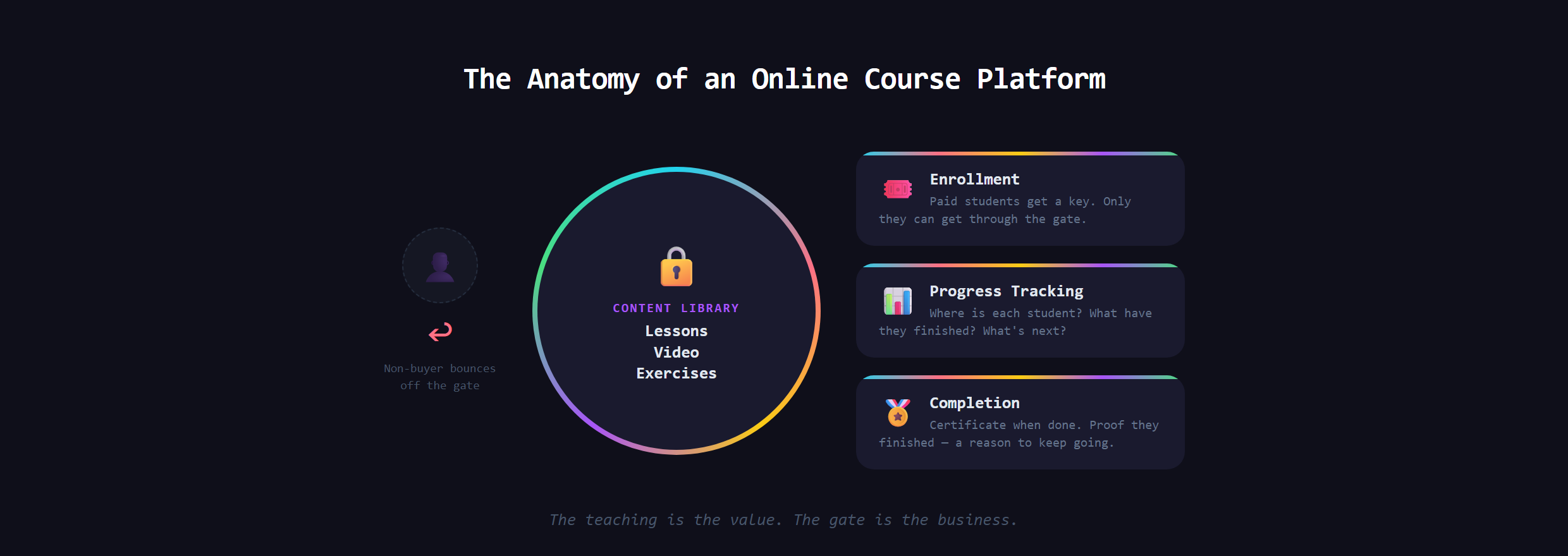
What is a course platform made of?
- The content library: your lessons, usually video plus text and downloads. Video is heavy, so it lives in file storage, not crammed into a database.
- Enrollment: the gate that decides who has paid and who is locked out. This is login plus access control.
- Progress tracking: the system that remembers where each student is and what they have finished, stored as structured data.
- Completion: certificates, scores, the sense of an ending that makes the whole thing feel worth it.
Why is access control the real product?
A course platform lives or dies on one question: can a non-buyer get the content for free? If your lessons are just public links, one screenshot in a group chat and your business is gone. So the platform's actual job is gating, serving the video only to enrolled students, only while they are logged in. The teaching is the value, the gate is the business. It is the same destination-not-directions logic behind why Make Anything With AI teaches the real how inside its lessons instead of giving it away.
Why does progress tracking matter so much?
People do not finish courses. That is the dirty secret of online learning. A blank folder of twenty videos is overwhelming, and overwhelmed students quit and ask for refunds. Progress tracking fixes the feeling: a clear next lesson, a bar that fills, a checkmark that lands. It turns a daunting pile into a path. Completion is not vanity, it drives refunds, reviews, and word of mouth, which is the entire growth engine of a course.
How does a course actually make money?
The model is beautiful: you produce the content once and sell it forever, with almost no cost to deliver the next copy. Three common shapes: a one-time price per course, a subscription to a whole library (the SaaS model applied to learning), or a free intro that sells a paid track. Many creators also run a surrounding content site to pull students in.
What makes a good course platform?
Reliable video, a dead-simple path through the material, progress that is always visible, and a smooth enrollment that does not make a paying student fight to get in. The operator also needs a back office to see enrollments, refunds, and who is stuck, which is what an admin dashboard handles. The best platforms make finishing feel inevitable.
Who builds course platforms, and why now?
Anyone with hard-won knowledge is a candidate: the expert who keeps answering the same questions, the creator with an audience, the business that needs to train staff or customers the same way every time. What changed is ownership. For years the only realistic option was to upload your course to a giant marketplace, hand over a cut, and rent your students from it. Running your own platform flips that: you keep the margin, you own the student relationship, and you decide how the whole experience feels. The same shift that made it sane for one person to run a SaaS now makes it sane to run your own school.
What goes wrong?
Leaky access (content that escapes the paywall), no progress tracking (so students drown and refund), video that buffers or breaks, and treating the course as a dump of files instead of a designed journey. A course platform is not a video host. It is a gated, guided path from "I do not know this" to "I do," and every part exists to get more people to the end.
Building a real course or membership platform, the gated library, the enrollment, and the progress tracking that keeps students finishing, is covered in Venom AI's Tier 3. Sell what you know once, and deliver it forever.