

Building a social app sounds simple until you try. Posts, profiles, a feed, a follow button, how hard can it be? Then you realize the feed has to choose what to show out of thousands of posts, two strangers somehow have to connect, and the second real people show up, so do spam and abuse. The features are easy. The systems behind them are the work.
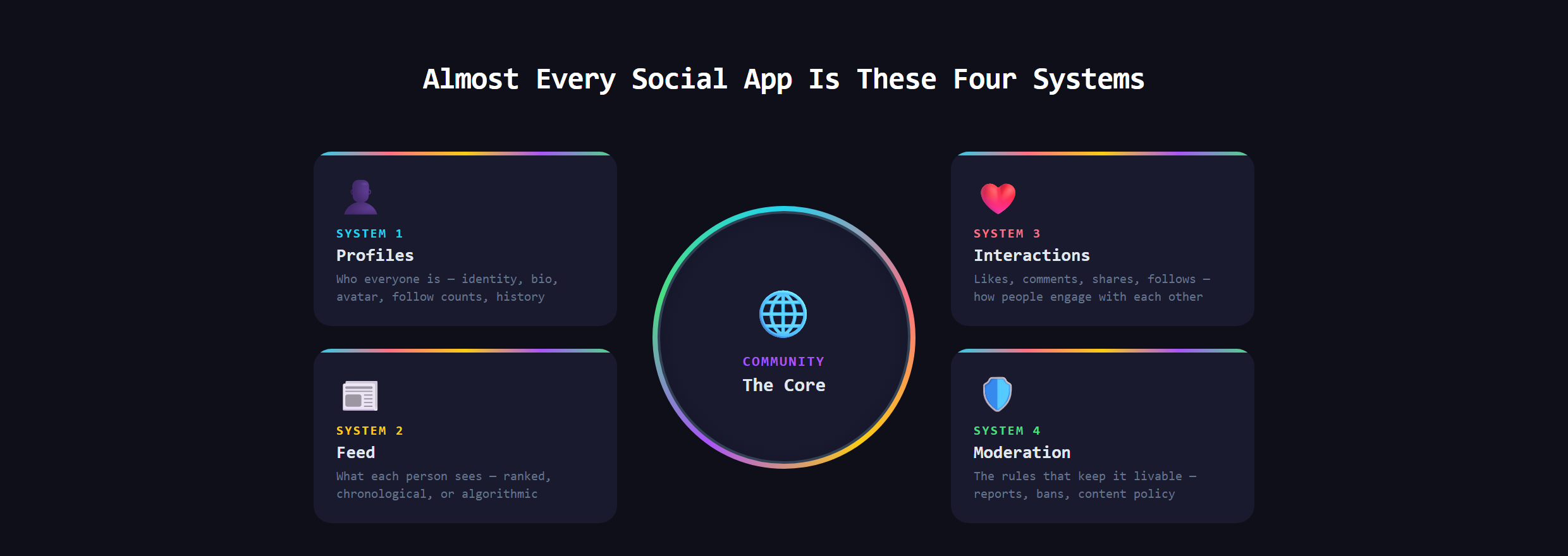
In short, a social app is built from four parts: profiles that represent each user, a feed that surfaces content, interactions (likes, comments, follows) that link people together, and moderation that keeps the whole thing safe enough to use. Strip away the branding and almost every social product is some arrangement of those four.
You have seen this anchor every day: open Instagram and the feed already seems to know what you want to see. That is profiles, interactions, and a ranking system working together quietly in the background.
What are the parts of a social app?
- Profiles:each user's identity, their name, photo, bio, and history. This is login plus a public face.
- The feed: the stream of content a user sees. The single hardest and most important part, because it decides what gets attention out of everything posted.
- Interactions: likes, comments, follows, shares, the connective tissue that turns isolated users into a network. These are usually real-time, so a like or a new message appears instantly.
- Moderation: the tools and rules that handle spam, abuse, and bad content. The part nobody notices until it is missing.
Underneath all four, every post, follow, and like is just related data being written and read at high speed, and the photos and videos live in file storage.
How does the feed actually work?
The feed is the heart of a social app, and it comes in two flavors. A chronological feed simply shows the newest posts first: honest and simple. A ranked feed scores every candidate post (how recent, how popular, how relevant to you) and shows the highest first. Ranking is what makes the big platforms addictive and also what makes them controversial. For a first build, chronological is the smart starting point. It is simpler, more transparent, and people actually trust it. You earn the right to rank later.
Why is moderation the part that decides everything?
Here is the lesson most founders learn the hard way: a social app is only as good as its worst content. The moment you let strangers post, you have invited spam, scams, and abuse, and if you have no way to handle them, the good users leave first. Moderation is the unglamorous back office of any community: report buttons, the power to remove content and ban users, and someone (or something) watching. This is where an admin dashboard stops being optional. A community without moderation does not stay neutral. It rots.
Why do niche social apps beat general ones?
Trying to build "the next big social network" for everyone is the classic trap. The giants already own general, and they own it through network effects: the app is valuable because everyone is already on it, which is almost impossible to dislodge. Niche wins instead. A small, focused community (one hobby, one profession, one town) is genuinely useful at a tiny size, where a general network is worthless until it is enormous. The same four systems, pointed at a specific group of people who actually want to find each other, is where new social apps still get built. That focused, ship-something-real product is exactly what Make Anything With AI is built to help you launch.
What goes wrong?
Social apps fail in recognizable ways. They chase "everyone" and never reach the critical mass that makes a network worth joining. They ship without moderation and get overrun the first time real traffic arrives. They obsess over a clever ranking algorithm before they have any content to rank, the empty-room problem, a feed of nothing that nobody wants to open. A social app is not a posting feature. It is a living community, and communities need a feed worth scrolling, a reason for the right people to gather, and rules that keep them there.
Building a real social app, the profiles, the feed, the interactions, and the moderation that holds it together, is covered in Venom AI's Tier 3. Get the four systems right and you are not shipping features, you are building a place people come back to.