

You have a brilliant marketplace idea: an Uber for this, an Airbnb for that. The app itself looks simple enough, a list, a search, a way to pay. Then it hits you. The hard part was never the software. It is that the day you launch, you have no sellers and no buyers, and an empty marketplace is useless to everyone who shows up.
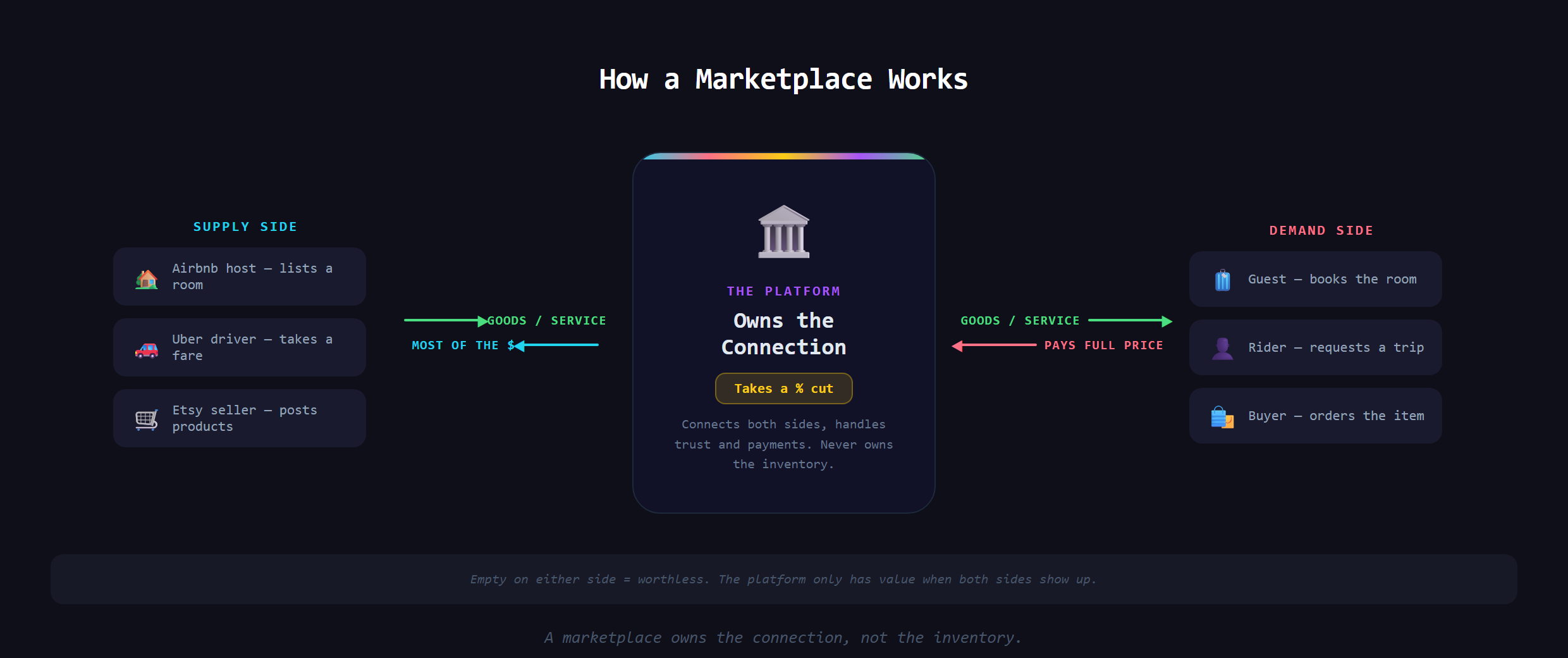
In short, a marketplace app is a business that does not own its inventory. It connects two groups (buyers and sellers, riders and drivers, guests and hosts) and takes a cut of the transactions it makes possible. The product is the matchmaking, not the goods.
What is a marketplace app, really?
A marketplace is a middleman with software. It does not make the product or provide the service. It owns the place where supply meets demand and the trust that lets strangers transact. You have used a pile of these: Uber owns no cars, Airbnb owns no homes, the app store sells software it did not write. What they own is the connection, and that turns out to be worth more than the inventory ever was.
How do marketplaces make money?
Almost always by sitting in the middle of the money. The classic model is a commission, a percentage of each transaction the platform helped happen (the same payment flow you have seen, with a split built into the middle). Some charge sellers to list, some sell featured placement, some take a subscription from the supply side. Whatever the mix, the platform earns because every deal flows through it.
What is the chicken-and-egg problem?
This is the one that kills most marketplaces, so it is worth saying plainly. Sellers will not show up without buyers to sell to. Buyers will not show up without sellers worth browsing. Each side is waiting for the other, and on day one you have neither. A half-empty marketplace is not half as good as a full one. It is close to worthless, because nobody finds what they came for, so nobody comes back.
How do real marketplaces solve it?
The ones that work almost never launch broad. They pick a side and seed it, often recruiting supply by hand long before it scales. They go painfully niche, owning one small category or one city completely before expanding an inch. The famous playbook is to win a market so small it looks unambitious, then grow outward from a place where supply and demand actually meet. Liquidity in one tiny corner beats emptiness everywhere else.
What goes wrong with marketplaces?
Beyond the cold start, a few traps recur. Leakage is the big one: the two sides meet on your platform, then cut you out and deal directly next time, so you lose the very cut you exist for. Others try to boil the ocean, spreading so thin that no single market ever fills up. And trust breaks easily, because you are vouching for strangers to each other, and one bad experience poisons both sides at once.
How do marketplaces build trust?
Since you are introducing strangers and asking them to exchange money, trust is not a nice-to-have, it is the product. Marketplaces manufacture it with ratings and reviews, verified profiles, secure payments held until a deal completes, and clear policies for when something goes wrong. The platform is quietly vouching for both sides, which is why a single scam or scary experience does so much damage. Get trust right and people transact freely with strangers. Get it wrong and the whole thing stalls no matter how good the matching is.
Why does niche win (and how does AI help)?
The throughline is focus. A sharp marketplace that completely owns one small world beats a generic one that is empty across a thousand. Building the software used to be a serious undertaking, but with an AI assistant in VS Code a solo builder can now stand up the matching, listings, and payments themselves. Knowing how the business actually works, not just how to code it, is the part that matters, and it is central to how Venom AI teaches you to Make Anything With AI.
Turning a marketplace idea into a real two-sided product, and beating the chicken-and-egg problem that sinks most of them, is covered in Venom AI's Tier 3. Own the connection, start absurdly small, and the rest follows.