

Booking looks like the simplest app in the world. Show a calendar, let someone pick a time, done. Then you hit the real questions: what counts as free, what happens when two people tap the same 3pm at once, and who reminds everyone so they actually show up. That hidden machinery is the whole product.
In short, a booking app is software that shows real availability, lets someone reserve a specific slot, locks that slot so no one else can take it, and then confirms and reminds both sides automatically. The pretty calendar is the easy ten percent.
You have seen this anchor in action: book a haircut, a doctor, or a table on OpenTable and instantly get a text confirmation. That is availability, a locked reservation, and an automated reminder firing in sequence.
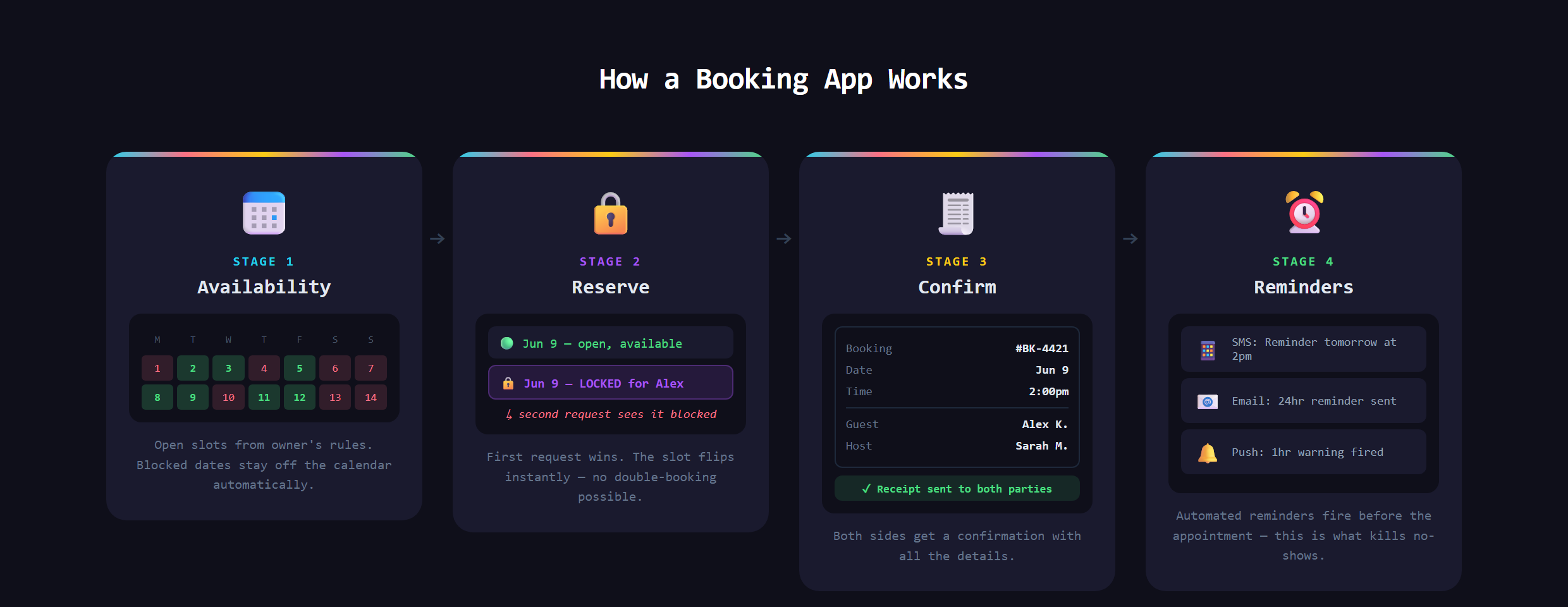
What is a booking app really made of?
- Availability: the rules for when you can be booked (hours, buffers, days off). This is the source of truth the calendar just displays.
- The reservation: the moment a slot flips from open to taken. It has to lock instantly so two people cannot double-book.
- Confirmation: the receipt that tells both sides it is real (the plumbing behind it is automated messaging).
- Reminders: the automated nudges before the appointment that cut no-shows. The unsung hero of the whole thing.
All of it sits on top of structured data: every slot, rule, and booking is just a record being read and updated.
Why is double-booking the hard part?
The scary scenario is two people grabbing the same time at the same second. A booking app has to treat reserving a slot as an all-or-nothing action: the first request wins and locks it, and the second is told it is gone, cleanly, before either side gets a false confirmation. Getting that race right is the difference between a tool people trust and one that books two haircuts into one chair. It looks trivial and absolutely is not.
Why do reminders run the whole business?
Here is the secret every salon and clinic knows: the money is not lost at booking, it is lost at the no-show. A chair you were counting on, empty, is pure waste. Automated reminders quietly recover a huge share of those, which is why the reminder system (not the calendar) is the feature that actually pays for a booking app. The craft of getting those messages delivered is its own skill worth knowing.
Where do payments fit?
Many booking apps take a deposit or full payment up front, for the same reason: skin in the game kills no-shows and protects your time. That turns a scheduler into a small commerce engine, with the same money handling any store needs. And the operator needs a back office to see the day, block off time, and handle cancellations, which is exactly what an admin dashboard is for.
What makes a good booking app?
The best ones disappear. Real-time availability so you never offer a slot that is already gone, the fewest taps to confirm, a calendar that respects time zones, and reminders that arrive at the right moment. The worst ones make you call to confirm, show stale openings, or forget to remind anyone. A booking app is judged on one feeling: did this just work without me thinking about it. That quiet reliability makes it a great, sharp first project to Make Anything With AI.
What kinds of businesses run on booking?
The same engine powers a surprising range of businesses, which is what makes it such a useful thing to build. Salons and barbers, clinics and dentists, consultants and coaches, tutors, classes and studios, equipment and venue rentals, even restaurant reservations all run on the identical core: availability, a locked slot, a confirmation, a reminder. Learn it once and you can point it at almost any appointment-based business. That breadth is also why booking is such a strong product to sell to a local business: the pain is concrete (a missed appointment is real money on the floor), the value is obvious, and the owner feels it every single week.
What goes wrong?
The classic failures: showing availability that is already taken (stale data), letting two bookings collide, skipping reminders and bleeding no-shows, and botching time zones so a 2pm call happens at the wrong 2pm. Underneath, they are all the same mistake, treating a booking app like a calendar screen instead of the careful state machine it actually is.
Building a real booking app, the availability rules, the slot-locking, the confirmations, and the reminders that run the whole thing, is covered in Venom AI's Tier 3. Master the slot, and the calendar is just the part people see.