

You can type a question to an AI all day long. But the moment you want to talk to it hands-free while driving, or point your phone at a broken appliance and ask what is wrong, plain text hits a wall. That wall is where voice and vision come in, and it is the difference between an AI you chat with and an AI that feels like it is actually in the room.
In short, voice and vision AI agents are agents that can hear you, speak back, and look at images or a live screen, instead of only reading and writing text. They take the same decide-act-repeat loop every agent runs on and bolt on real human senses.
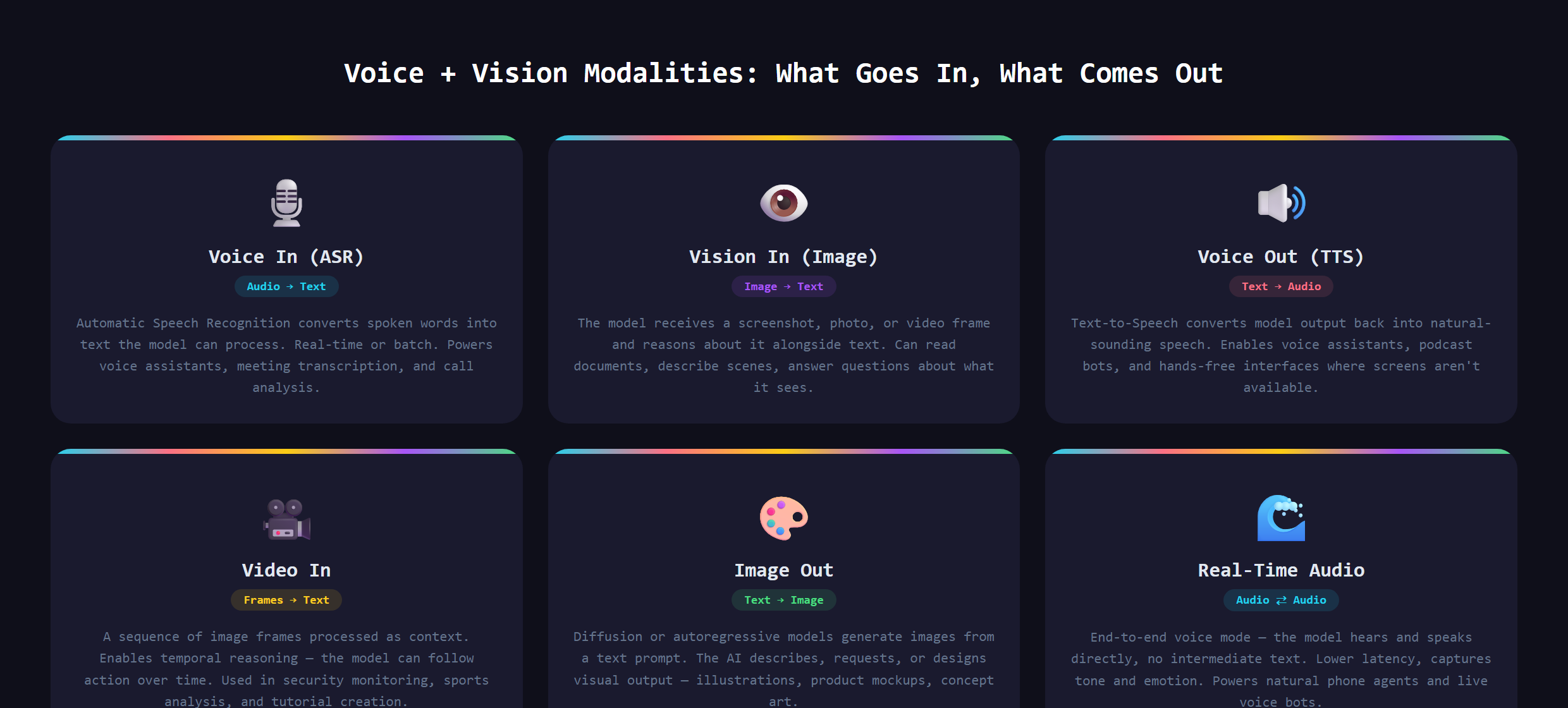
What does it mean to give an agent senses?
A normal AI agent is a loop. It takes a goal, decides the next step, uses a tool, reads the result, and repeats until the job is done. That loop does not care whether the input arrived as typed text or something else. That is the key insight here. You are not building a different kind of AI. You are feeding the same loop a richer signal.
Voice adds two abilities: turning your speech into words the model can read, and turning its answer back into a spoken voice. Vision adds one big one: letting the model look at a picture, a screenshot, a document, or a live camera feed and understand what is in it. Stack those on the loop and the agent can suddenly hold a conversation or react to what it sees.
Where have you already seen this?
You have used early versions of this without thinking about it. When you ask a smart speaker for the weather and it answers out loud, that is a voice loop. When your phone camera offers to translate a foreign menu you are pointing it at, that is vision. When a banking app reads a check you photographed and fills in the amount, that is vision plus a tiny bit of reasoning. The newer wave just makes that brain dramatically smarter and lets it take action, not only report what it noticed.
Why this matters for what you can build
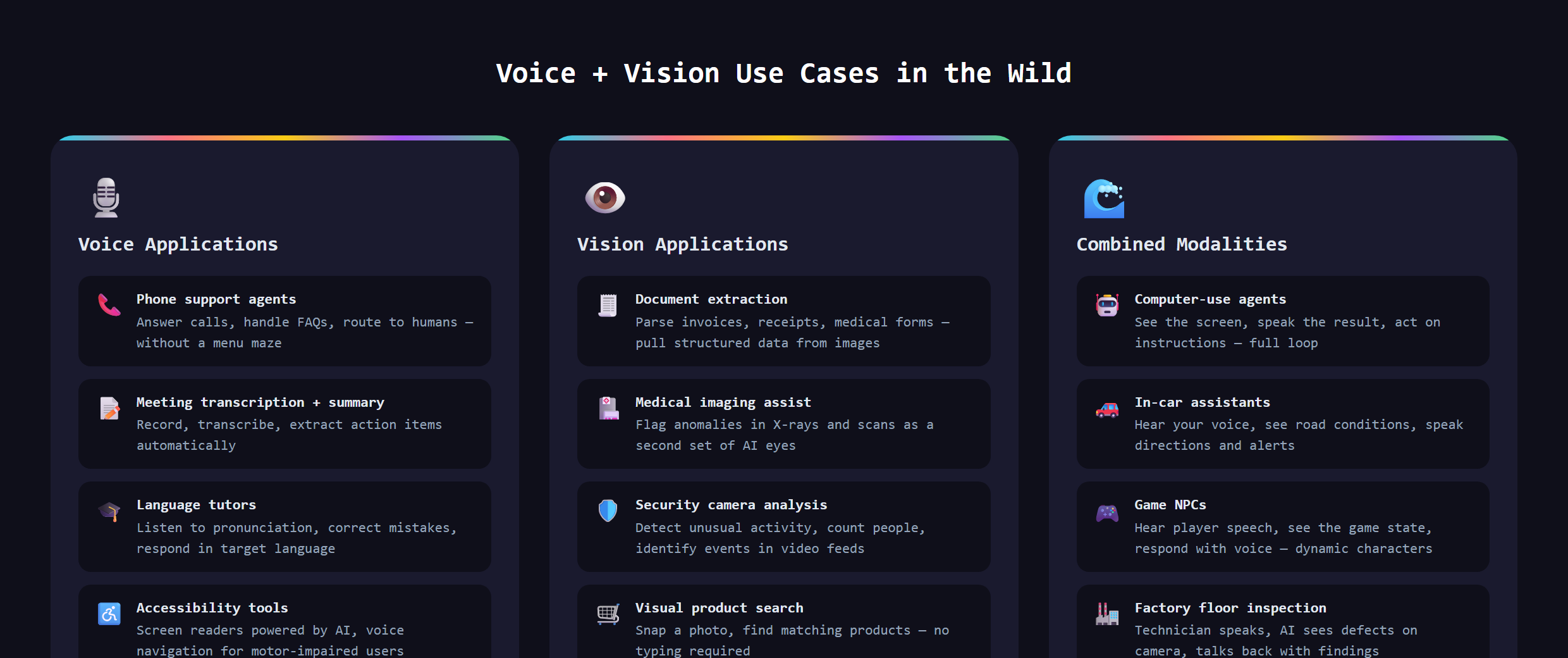
Senses unlock whole categories of product that text alone cannot reach. A voice agent can run a phone line that actually helps callers instead of trapping them in a menu. A vision agent can look at a photo of a rash, a receipt, a damaged car, or a cluttered warehouse shelf and do something useful with it.
It also removes friction. Talking is faster than typing for most people, and a lot of the world does not live inside a keyboard. Letting someone hold up their phone or just speak meets them where they already are. That is why voice and vision sit in the most advanced tier of what we teach at Venom AI. They are where AI stops being a tool you visit and starts being an assistant you use.
What makes voice harder than it looks
The tricky part of voice is not the talking, it is the timing. A real conversation has rhythm. If the agent takes three seconds to answer, it feels broken. If it talks over you when you pause to think, it feels rude. Good voice agents have to listen, think, and speak nearly all at once, and they have to know when you are actually finished talking. That choreography is the real craft, and it is the part beginners almost always underestimate.
Vision has its own catch. A model can describe a picture beautifully and still get a critical detail wrong, like misreading a number or missing something at the edge of the frame. So the smart move is to let vision handle the messy human part (looking, summarizing, flagging) while something more reliable handles the part where being wrong is expensive.
How it connects to the rest of building with AI
Voice and vision are not a separate world. They sit on top of everything else. Underneath, you still have the same agent loop, the same AI features wired into an app, and often the same tools the agent reaches for. Senses are the front door. The reasoning and the wiring behind them are the parts you already know how to think about.
Building agents that hear, speak, and see, and getting that timing to actually feel human, is covered in Venom AI's Tier 4, part of how we teach you to Make Anything With AI. Once you understand the senses are just new inputs to the same loop, the whole field stops looking like magic.