

Making a game sounds like the hardest, most advanced thing a beginner could attempt, the thing you do after years of "real" coding. So most people never try. Which is a shame, because a small browser game is one of the most achievable and motivating things you can build, especially now.
In short, a browser game is a game that runs right inside a web page (no download, no app store), built on the same core technology as any website, with a loop that updates the action and redraws the screen many times per second. If you can open a link, you can play it.
You have seen this anchor in any quick puzzle or io-style game you have played in a browser tab without installing a thing. That is a browser game doing its whole job inside the page.
What is a browser game, under the hood?
A browser game uses the same building blocks as the rest of the web. The page handles input (taps, clicks, keys), some logic decides what happens (you moved, you scored, you died), and the screen redraws to show the new state. Do that fast enough, many times a second, and still images become motion. For richer visuals there is a dedicated drawing surface the game paints on, but the mental model stays the same as building any web page, just running on a loop.
What is a game loop?
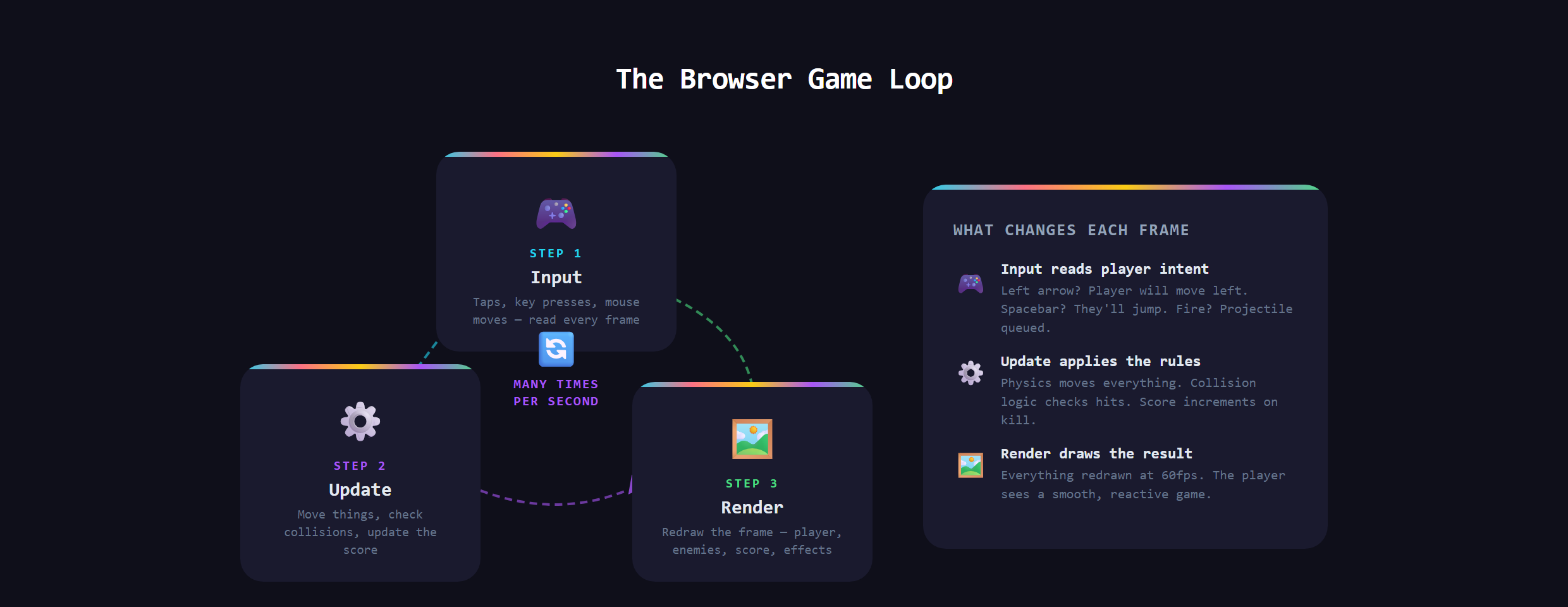
The heartbeat of every game is the loop. Over and over, dozens of times a second, it does three things: take input, update the state (move enemies, check collisions, tally score), and render the new frame. That is it. A platformer, a puzzle, a space shooter, they are all the same loop with different rules inside. Once that clicks, games stop feeling like black magic and start feeling like a pattern you can reason about.
Why is AI unusually good at building games?
This is the fun part. AI assistants shine at browser games for three reasons. They run on web technology, which is exactly what AI knows best. They are visual and self-contained, so you can run it and instantly see whether it works, no guessing. And the feedback loop is immediate and a little addictive: you tweak a number, the character jumps higher, you feel it right away. That tight see-it-now loop is perfect for building with an AI assistant in VS Code, and it is why a game is one of the most rewarding first projects at Make Anything With AI.
Why is a game a great way to learn?
Games sneak in real skills. Handling input, managing state, structuring logic, making things appear on screen, these are the same fundamentals behind serious apps, just dressed up as fun. And because the result is playable, you actually stay motivated to finish, which is more than most tutorials can say. The little hit of "I made a thing that is fun" carries you through the parts that would otherwise feel like a chore.
How do browser games get out into the world?
The huge advantage is distribution: it is just a link. No app store review, no install friction. You host it like any website and anyone with a browser can play instantly. Some games are pure fun, some carry ads, some are a clever marketing piece for another product. But it is the lowest-friction path from "I built it" to "someone is playing it" of almost anything you can make.
What kinds of browser games actually work?
The web rewards small and replayable, not sprawling and cinematic. The games that thrive in a tab are the ones you can start in a second and lose yourself in for a few minutes: quick puzzles, arcade high-score chasers, idle and clicker games, and the daily one-shot puzzle that a whole group races to beat before lunch. Short sessions, instant restart, and one mechanic done well are the pattern. It is the same lesson as scope, just pointed at design: a tiny game that is genuinely fun to replay beats an ambitious one nobody finishes building.
What goes wrong?
The classic trap is scope. Beginners try to build a sprawling 3D epic and quit at five percent done. The fix is starting tiny: one mechanic, one screen, finished. Others ignore performance and the game stutters, or they pile on features instead of making the one core loop genuinely fun. A game is not its feature list. It is one loop that feels good to play, polished until it does.
Building a real browser game from that core loop, and the patterns that make it fun instead of janky, is covered in Venom AI's Tier 3. Start with one mechanic that feels great, and the game builds itself around it.