

You keep wishing a website you use every day did one more thing. Hid the clutter, added a button, pulled out the info you actually care about. The site will never build that for you, but you can bolt it on yourself, and the tool for that is a browser extension.
In short, a Chrome extension is a small program that lives inside your browser and changes how the pages you visit look and behave. It is one of the lowest-effort ways to ship real software to real people, which is exactly why so many builders start here.
What is a Chrome extension, really?
Picture the browser as a house you already live in. An extension is a smart gadget you install in that house: it can rearrange a room, watch for something to happen, or pop up a little control panel when you click it. It does not replace the browser. It rides along inside it and adds powers.
You have seen this on Grammarly, which quietly checks your writing inside every text box on the web, or on a password manager that offers to fill your login the second a sign-in form appears. Neither of those is a website you visit. They are extensions, living inside the browser, acting on the pages you were already on.
What are the pieces it is made of?
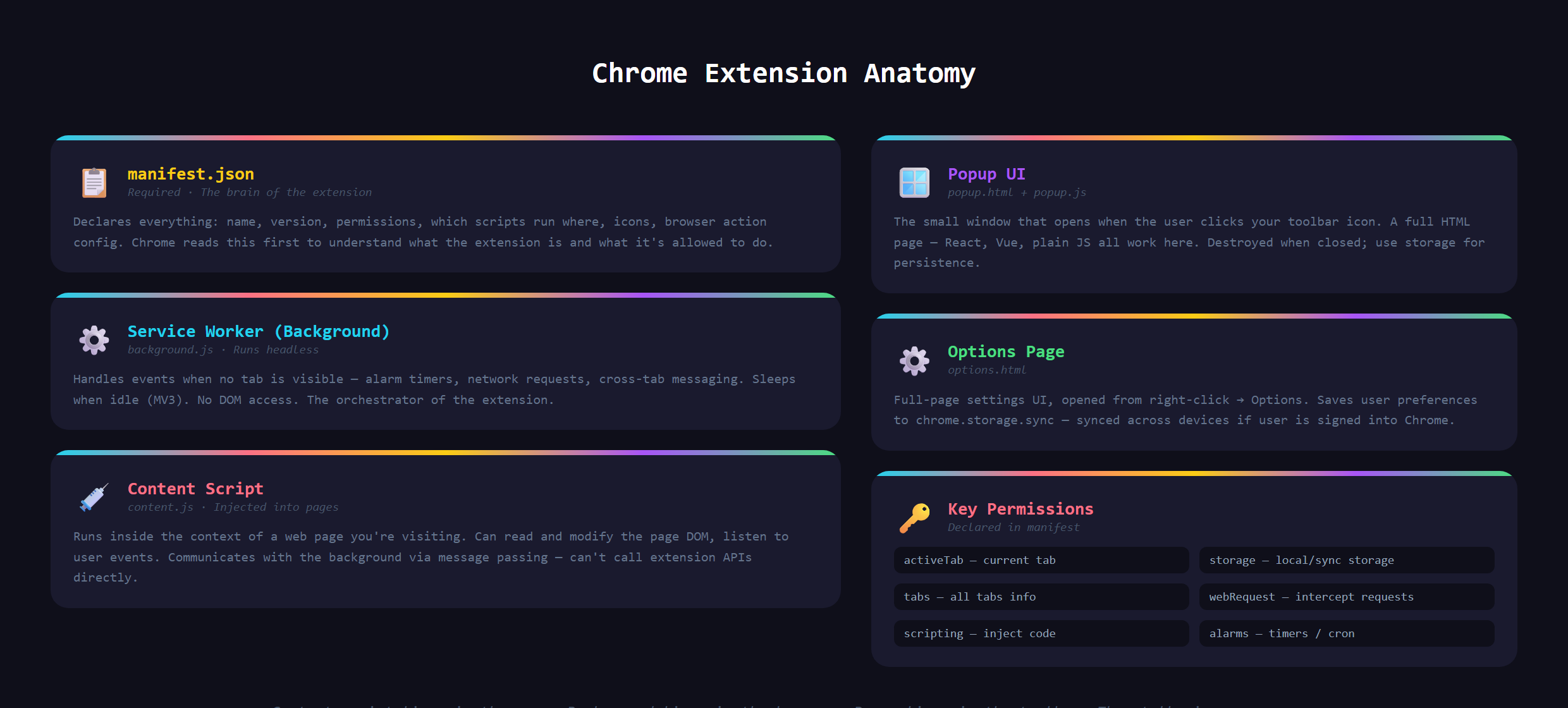
Under the hood an extension is a handful of cooperating parts, and once you can name them the whole thing stops feeling mysterious:
- The popup: the little window that appears when you click the icon in your toolbar. This is the control panel.
- The content script: the part that can actually reach into the page you are looking at and change it, hide things, add things, read things.
- The background worker: the quiet part that runs behind the scenes, watching for events and keeping track of state.
- The manifest: a small settings file that declares what the extension is and what it is allowed to touch.
The good news for an AI builder: an extension is built from the same web languages a normal website uses. If you can describe a webpage, you are most of the way to describing an extension.
Why is this the easiest software to ship?
Most software has a distribution problem. You build a thing, then face the hard part: getting anyone to find it, download it, and trust it. An extension sidesteps a lot of that. The browser is already installed on more than a billion machines. The Chrome Web Store is already a storefront people browse on purpose, looking for exactly this kind of small tool. You are not begging people to install a strange program. You are dropping a listing into a place they already shop.
That is why extensions are such a friendly first product. The audience, the platform, and the store are all sitting there before you write a single line. This sits right next to publishing a CLI tool to npm on the spectrum of small, shippable things, and one notch easier than a full Electron desktop app.
What goes wrong without understanding the rules?
The catch is permissions. An extension can be powerful, which means it can also be dangerous, so the store reviews what you ask for. Request the right to read every page on the web when your tool only needs one site, and you invite a slow review, nervous users, and the risk of a rejection.
Builders who skip the why here ship extensions that demand far too much access, scare people off at the install screen, or quietly break every time the host site changes its layout. Knowing what each piece is for is what keeps your extension lean, trusted, and approved.
How does an extension make money?
Plenty of extensions are free passion projects. Plenty are real businesses. The usual paths are a one-time unlock, a subscription gated behind a login, or a free extension that acts as the front door to a paid web app. Because the store handles discovery and the install is one click, the distance between a useful idea and a paying user is unusually short.
Building a real Chrome extension, from the manifest to the content script to a clean store listing, is covered step by step in Venom AI's Tier 4, part of how we teach you to Make Anything With AI. Learn the pieces, and the next time a website annoys you, you will see a product instead of a complaint.