

The first time you watch an AI write a working program from a sentence, it feels like cheating. The second time, you start to wonder how on earth it is doing that, and whether you can trust it. That second question is the important one, because the answer is what separates people who get great results from people who get burned.
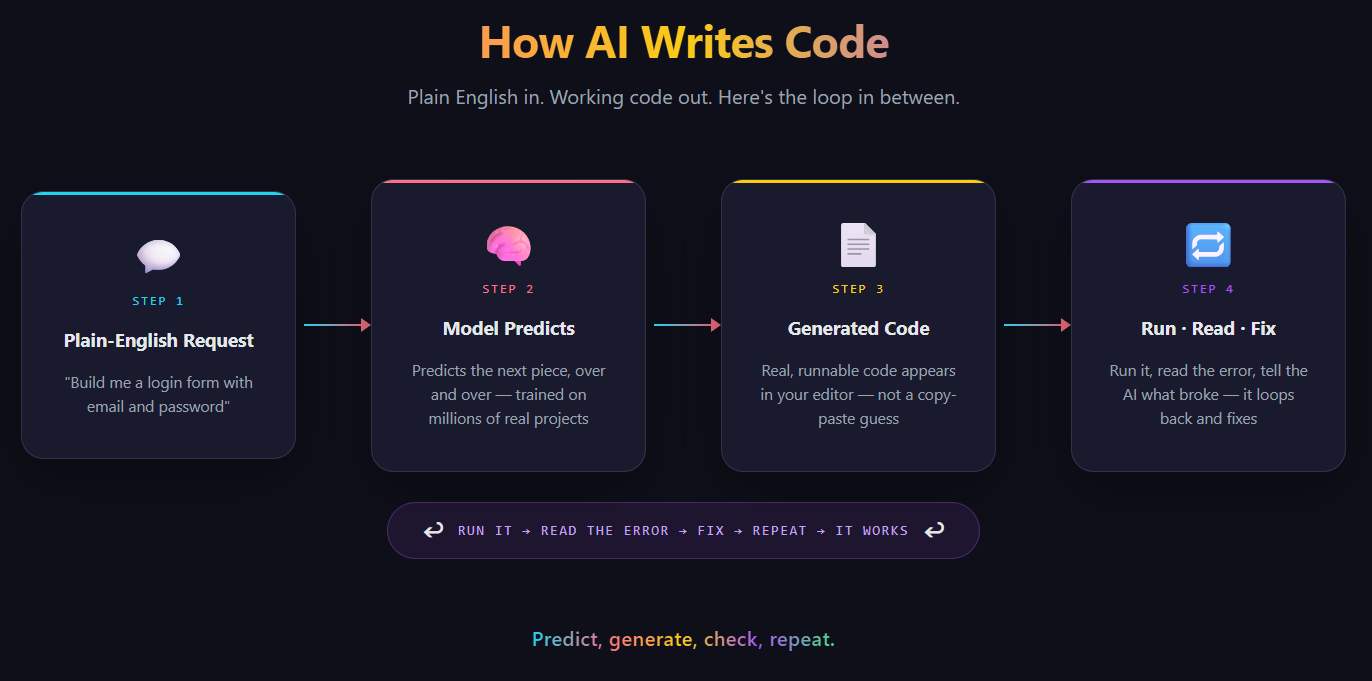
In short, AI writes code by predicting it, one small piece at a time, based on patterns it absorbed from millions of real programs, not by looking up answers or truly understanding your project the way a person would.
It predicts, it does not look things up
The mental model most people start with is wrong in a useful way to correct. They imagine the AI has a giant library of finished programs and it goes and fetches the right one. That is not what happens. The AI was trained by reading an enormous amount of real code, and in the process it learned the deep patterns of how code tends to fit together. When you ask for something, it generates a fresh answer by repeatedly predicting what piece should come next, given everything so far.
You have seen the toy version of this every day. When your phone suggests the next word in a text, it is predicting from patterns it learned. Now imagine that same idea trained on millions of programs instead of text messages, and powerful enough to keep the whole shape of a project in mind while it predicts. That is, in plain terms, how the code appears.
Why it is so good, and where it slips
This prediction approach is the reason AI is genuinely brilliant at the common stuff. A login form, a contact page, a way to save data, these have been written so many times that the patterns are rock solid, and the AI reproduces them cleanly. The more ordinary and well-trodden your request, the more reliable the result.
It also explains the failures. Ask for something unusual, or describe it vaguely, and the AI fills the gaps with the most likely guess, which may not be what you meant. It can write code that looks completely confident and is quietly wrong. It is not lying, it is predicting, and a confident prediction and a correct one are not always the same thing. Knowing that is your early-warning system.
This is why your words carry so much weight
If the AI is predicting from your request, then your request is the steering wheel. A clear, specific instruction points the prediction straight at what you want. A fuzzy one leaves the AI to guess, and it will guess in the most average direction, which is rarely what makes your idea special. This is why the same tool produces a polished result for one person and a mess for another. The tool did not change. The direction did.
Getting good at that direction is a real skill with real technique behind it, and it is the core of how we teach building at Venom AI. It is far less about memorizing code and far more about learning to describe what you want in a way that aims the AI precisely.
What goes wrong when you skip the how
People who never learn what is going on under the hood tend to swing between two bad extremes. Either they trust every answer blindly and ship broken work without realizing it, or they get one confident wrong result, decide AI is useless, and give up. Both come from the same place: not knowing that the AI is a powerful pattern-predictor that needs a clear hand on the wheel. Understand that, and you stop being surprised and start being in charge.
The actual craft of writing requests that get correct code the first time, the prompting fundamentals that turn this prediction engine into a reliable builder, is taught in Venom AI's Tier 1. Once you understand how the code really gets written, learning to direct it is what lets you Make Anything With AI instead of fighting it.